
It took a while, but over the years I've come to realise true self-sufficiency is an impossible goal.
The only way to achieve it is through community. A group of people working hard together with animals can get pretty close. But one or two people will always struggle.
We have—at best—a pencil-sketch of an outline of self-sufficiency here. We could scale-up, but the current reality is there's simply too much work for the amount of available labour and skill to achieve.
Richard and I are fortunate that the resources we grow allow us to work less, but we both still work off-farm jobs to pay for the things that cost cash-money.
We can't pay our internet bill with bunches of bananas.
A shift in perspective
Sitting here in 2026, events have happened—and are happening—which have made it worth thinking more deeply about where my food comes from.
I've found myself considering what I might do if the things I expect to find for a reasonable price suddenly aren't available, or are unaffordable.
It's kind of been the whole point all along. It just seems less-wild as a concept now than it did in 2010 when I first began thinking about a life like this; or even 2019 when we moved in.
Growing things is only one part of the puzzle. The real problem and the lesson I guess I've learned since then is that once it's grown, food needs to be processed and stored.
More often than not, that's the bit that takes most of the skill, energy, and time.
One of the things we've struggled to process more than grow, and which we still have to buy is grains—especially flour.
We're mostly self-sufficient in potatoes, and this year we also added kūmara to the garden. That covers some of our carbohydrate needs.
But growing wheat, oats, barley, and even millet requires so much work for a tiny return. The kind of volume we need for breads and baking, let alone chicken food remain out of reach.
And then there's the bananas
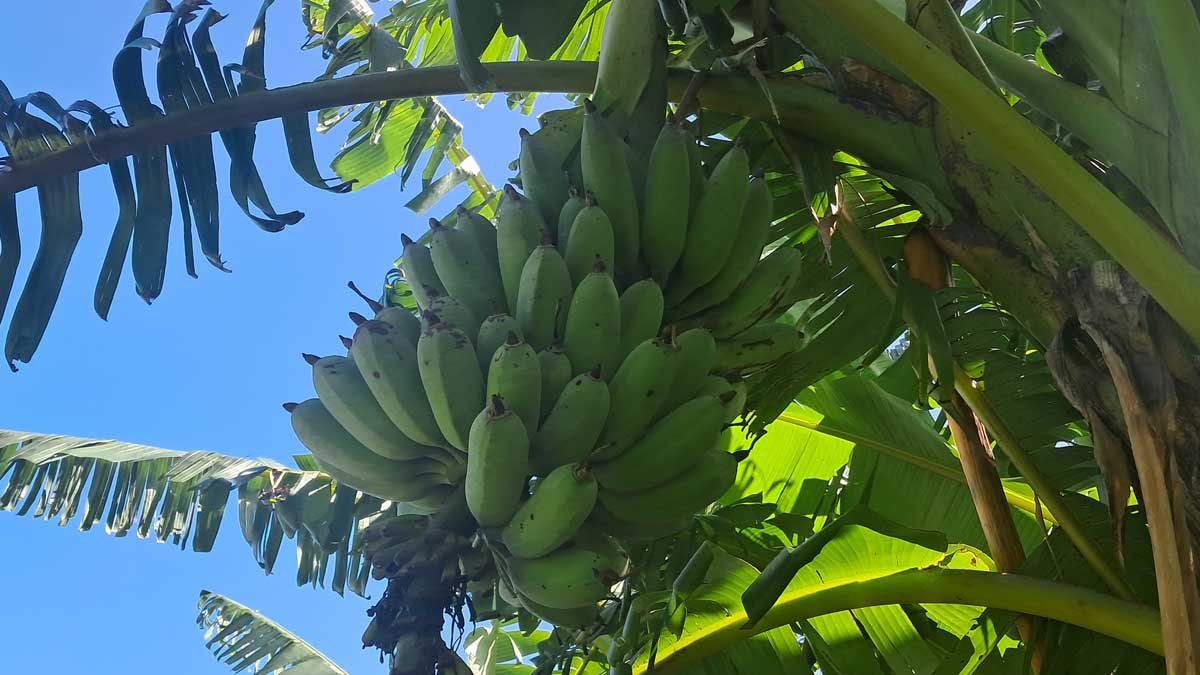
We planted our bananas in December 2019, so the clumps are pretty well established now. And they grow so much food.
But after you harvest an arm of 80-100 bananas, you have about 2 weeks to eat them. Again, this is a moment where community is helpful. It's really overwhelming for two people.
I tried selling them, but bananas are expensive to ship. Very few people want to pay $30 worth of postage on $10 worth of bananas.
When they are ok with that, if things I can't control go pear-shaped, it requires customer service on a level that wasn't worth the $10 to me.
So I give a lot of them away, placing them in local pātaka kai (community pantries), and giving them to neighbours, family, and friends.
We eat what we can. And still, there are so many bananas.
Survival food
So if the apocalypse comes in one of the more currently-relatable forms of oil crisis, global pandemic, or climate change, we're kind-of set for bananas.
At least for the week or two when they're good to eat, on their own irregular ripening schedule.
And I was still looking for something to perform the role of a grain.
Then I found out, bananas might fit the bill. How convenient!
Not only can bananas be dried and milled into a flour, that flour is also kind of amazing?
It has high levels of resistant starch, making it low GI, and suitable for people concerned about their blood sugar. It's also gluten-free.
That sounded like something maybe worth investigating.
Bananas grow so abundantly here that maybe I could figure out how to pay the internet bill with bananas after all.
Making green banana flour
The basic idea is you take green bananas, peel them, and chop them up into slices.
Then you soak the slices in some water with half a lemon squeezed into it (to stop them browning); dehydrate them at 55ºC for about 15 hours or until they snap cleanly; then grind them up into flour.
Simple. I could do that.
Then—or at least I was told—you use that flour pretty much the same way you would for any flour. Obviously, that's an experiment worth trying.
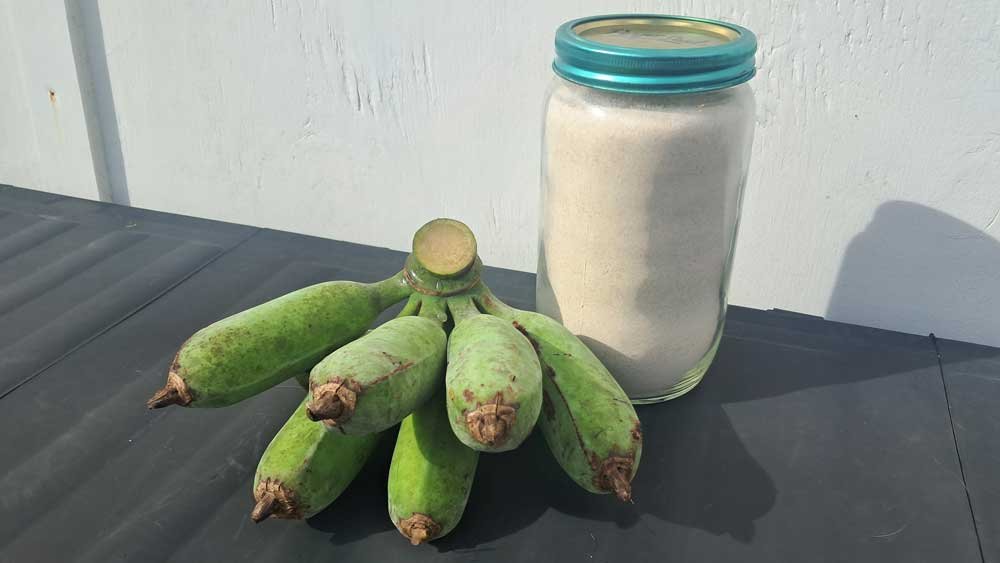
It took 28 Ladyfinger bananas to fill up the dehydrator. Less than half of the arm I harvested for the job (shown above).
I ran into some issues along the way though.
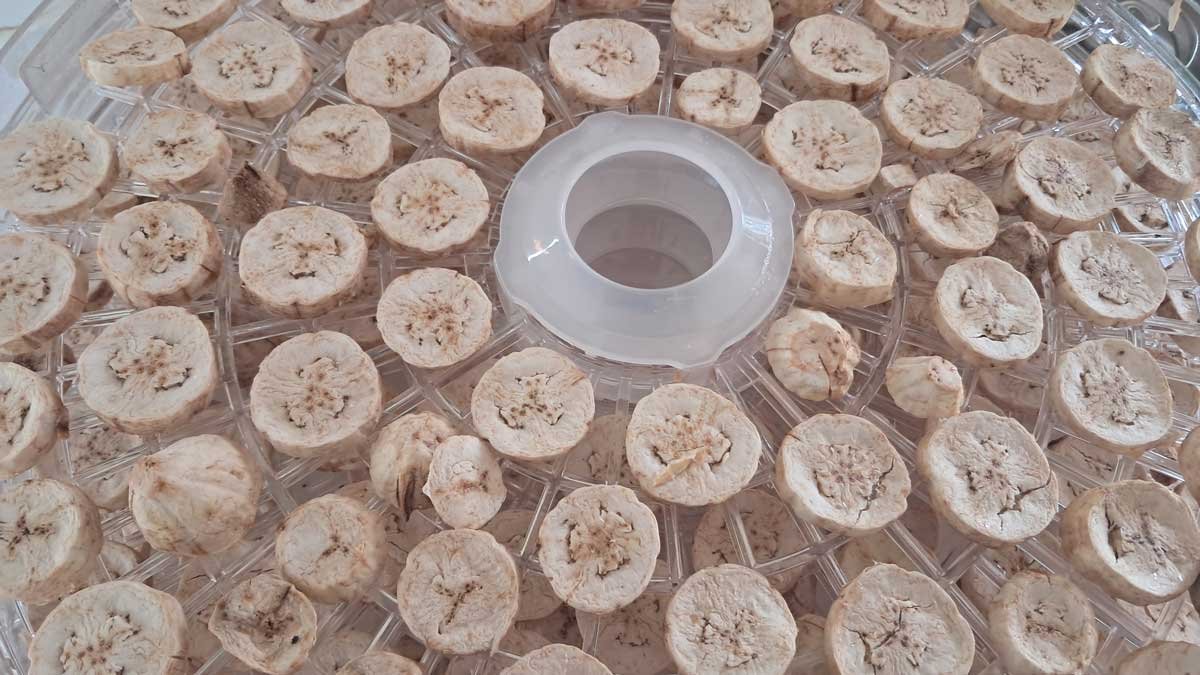
My major warning to you if you're planning to try this is beware of banana sap! It oozes from every fresh green banana, and gets everywhere, on everything.
It's very sticky and it contains tannins, which will leave stains. Cleaning up involved cooking oil and isopropyl alcohol to help shift the sticky banana sap.
So wear disposable gloves, and old clothes. Protect equipment and floors. Have a bucket ready to take the skins.
Dehydrating went well, but then I ran into more issues while trying to use my food processor.
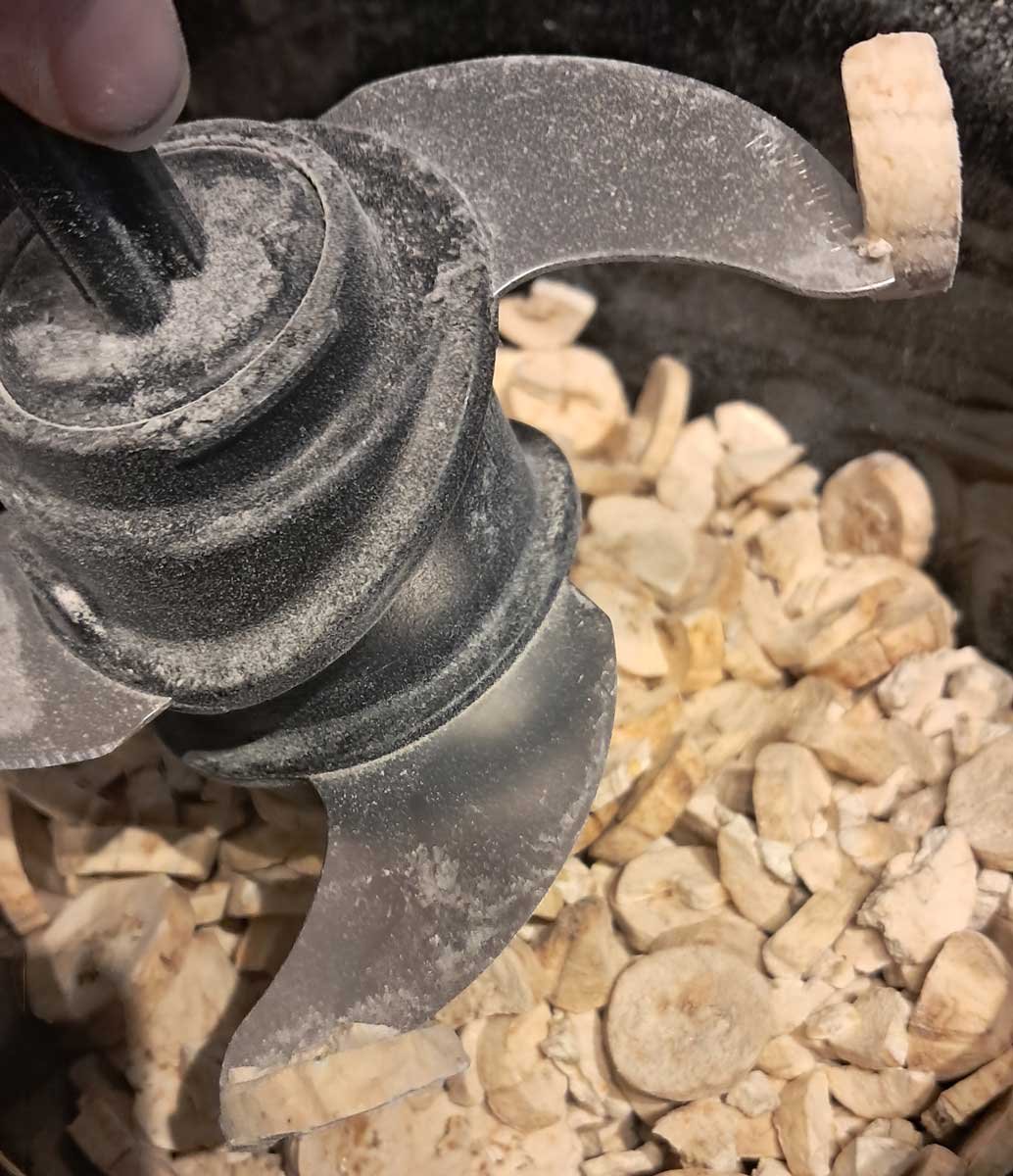
The banana chips kept getting stuck on the blade, wedging it against the wall of the jug, and causing an error.
So I had to abandon that method and switch to my coffee grinder. It got the job done, but it took a while. I worked in small batches, sifting the flour as I went.
At the end of all that I had 750g of homemade banana flour. A remarkable amount of flour compared to the amount of bananas I still had left!
I could probably make at least 2 kilograms of flour from an arm if this was any good.
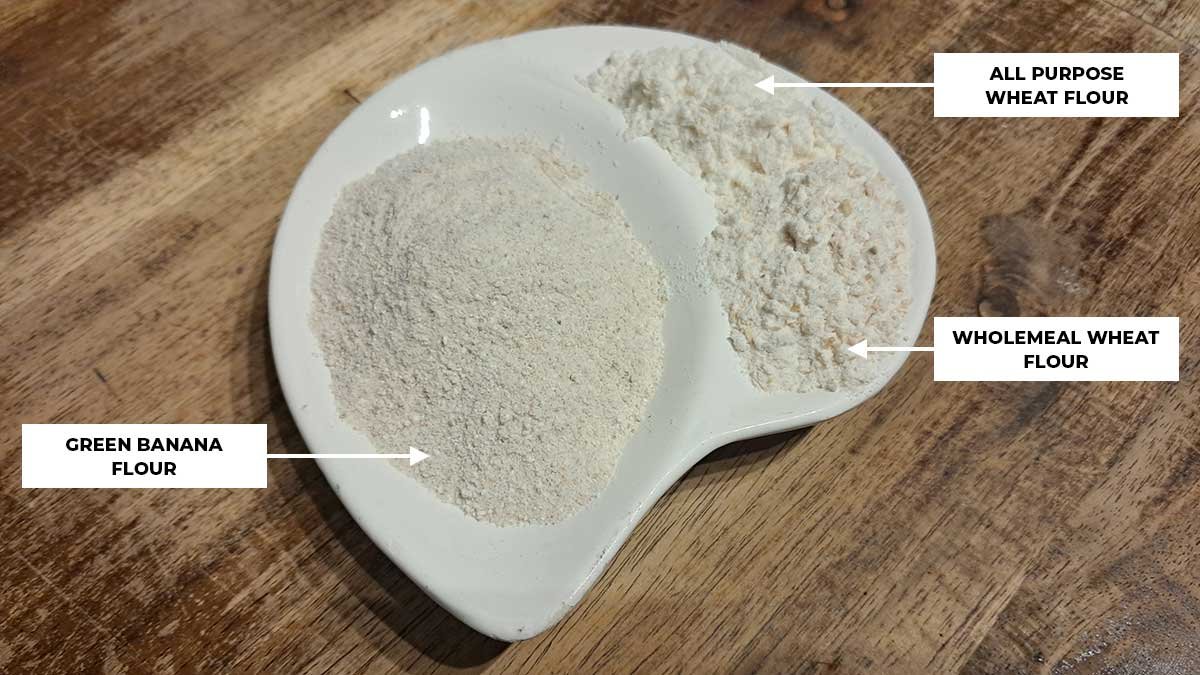
The final product is light. It smells sweetly of banana—the fragrance stands out when you use it. It's white, and looks a lot like any other flour in my kitchen.
Eating banana flour
I decided to test my flour with a batch of pancakes. It's a simple way to find out if this whole idea is even worth the effort.
I googled a few recipes for green banana flour pancakes and created my own aggregate version.
I combined banana flour, milk, baking powder, an egg, and small amounts of salt, sugar, and sunflower oil. On the first test, I avoided any vanilla or cinnamon, I wanted to get a feel for what I was working with.
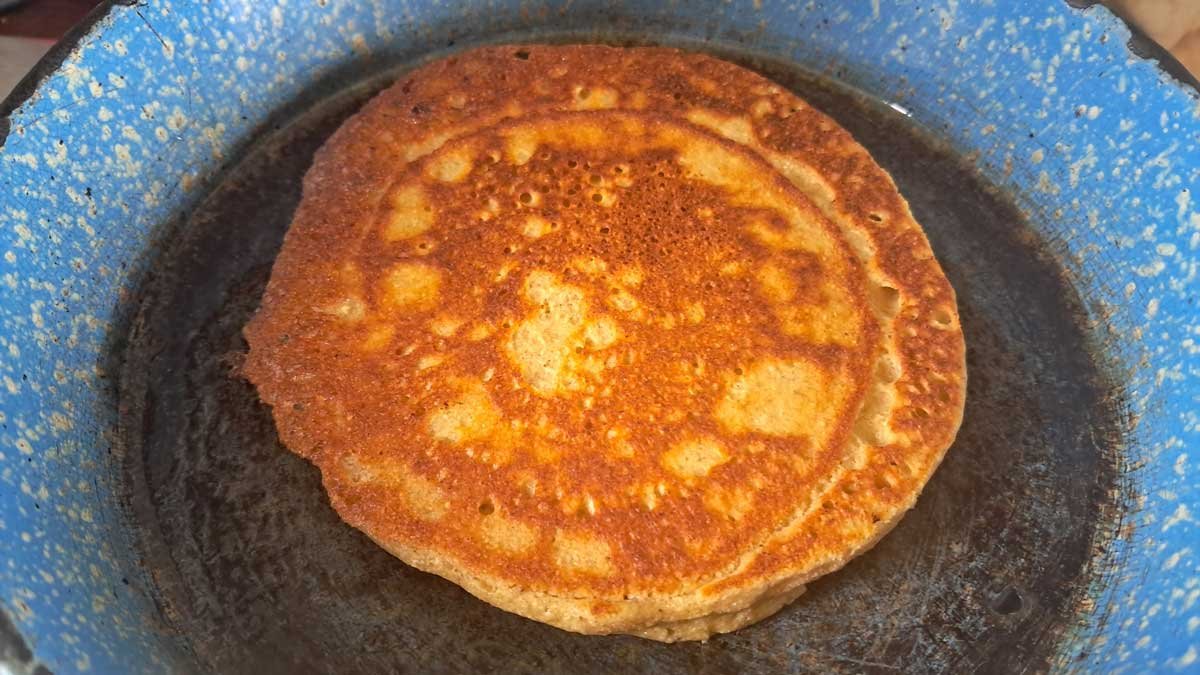
What I discovered was utterly unsurprising when I thought about it. The pancake reminded me a lot of those '3 ingredient pancakes' with a mashed banana and an egg.
Turns out, banana flour is basically dehydrated mashed banana.
Green banana flour pancakes are totally edible, but that's about the most I have to say for them.
Because the bananas were green, the flavour was light, if a bit bland. Very cake-like as a texture. Bumping up the flavour with some cinnamon, vanilla, or sweetener would go a long way.
But this was definitely not a flour replacement any more than a mashed banana is.
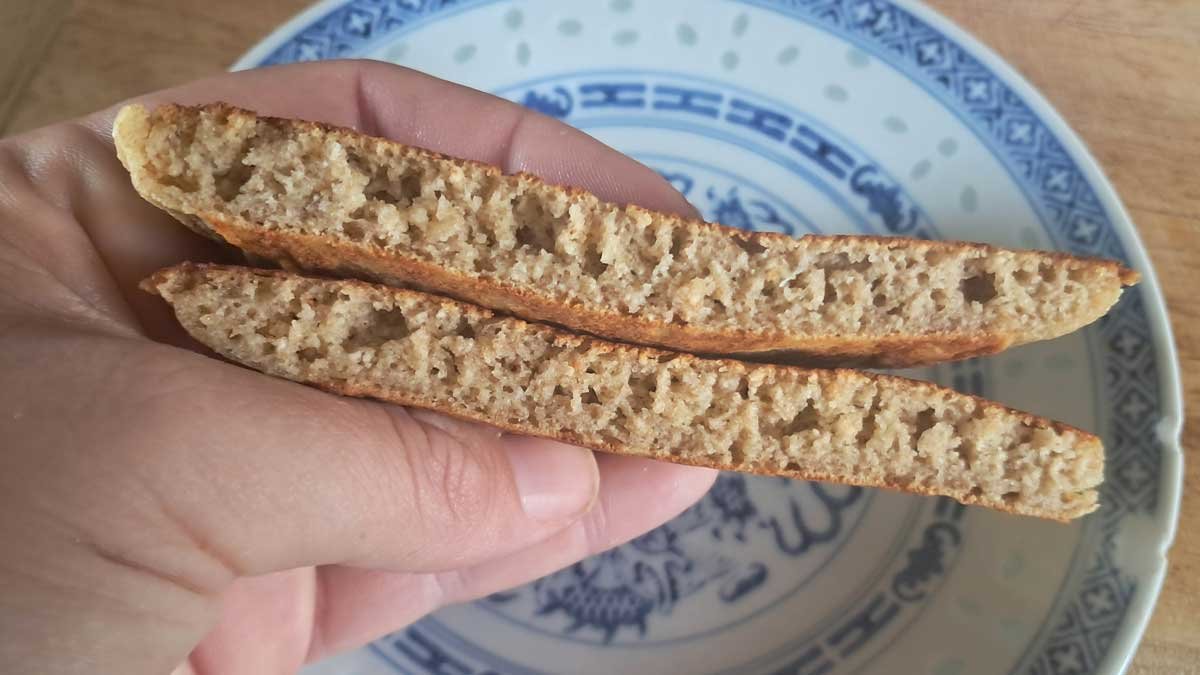
Still, at least in this form our bananas became a shelf-stable product that I can produce and store a lot of.
The pancakes weren't a failure, and they gave me some clues about how else I could use green banana flour.
I'm not sure I'll ever be able to make a good loaf of bread from banana flour by itself. It needs another flour to provide more structure.
The banana pancakes lacked something in the texture which I think is provided by gluten in wheat, so bread feels like a step too far. Still, Richard and I both agreed we could eat green banana pancakes for a long time if we really had to.
Perhaps I'll try some kind of banana muffin next time and see how it goes as a banana substitute, rather than as a flour.
Is it worth it?
I don't think it's remotely worth buying bananas to dehydrate them into green banana flour. You need a lot of them and green banana flour is also available in some health stores, buy that if you must have it.
The process of peeling, preparing, dehydrating, and then grinding the bananas is pretty intense (and very sticky). It's a lot of work to go through for no real reason.
However it shows promise as a way to preserve your own banana harvest. It could be a decent banana substitute in recipes with less fructose and more resistant starch than a yellow or blackening banana.
It's shelf-stable, and has been sitting in our cupboard for about six weeks now with no signs of degradation. The arm of bananas is long gone, but we still have the fruit in the form of this flour.
So it doesn't really get me closer to a grain, but it does offer one way to make our bananas go longer. We have all the equipment on hand to make it in small batches indefinitely, and the raw materials keep growing at an almost-problematic rate.
It's pretty comparable to smoking a batch of paprika in terms of work and mess, but I think there are health benefits worth keeping it around for.
It's not an unwelcome addition to my kitchen stock, but I don't think I'll be paying that internet bill in banana flour any time soon either.
READ NEXT
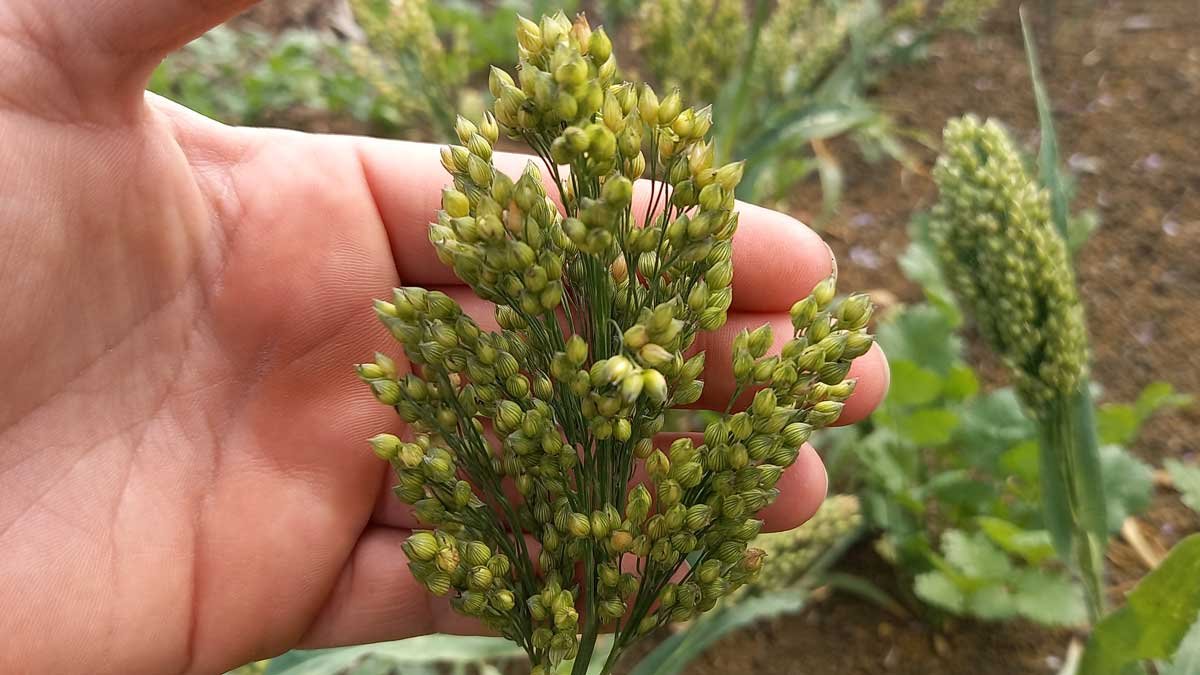
The International Year of Millets
The time I tried growing millet because the UN said it was cool.
READ NEXT
The pursuit of self-sufficiency
Turns out, self-sufficiency is harder to achieve than it sounds, and we'll probably never get there.
Related content: bananas · climate change · cost of living · dehydrating · diabetes · drying · experiments · food preservation · food storage · harvest · ladyfinger · millet · misi luki · pātaka kai · processing · recipes · Richard · rural economy · self-sufficiency · sustainability · The Outpost
Stay in touch?
The Kat's Garden newsletter gives readers an extra peek behind the scenes. It's the best way to know when new posts go live, and what's happened since.
If you like what you've seen, join us and see what we learn next.



how fascinating. I totally agree with the community sufficiency idea. It’s one I have heard of just in the last couple of years Anna of Wai-iti ridge and Angela of the Food farm and Eat New Zealand ( among others I am sure) bought this to my attention. Angelia was explaining that she doesn’t grow grains because of the big commitment to get a crop and having a local grain grower in North Canterbury, Millmore downs, but they do grow corn for Masa flour and are sufficient in that.
The longer I live here, the more I appreciate modern agriculture. Corn still requires a lot of water, and when we first arrived we had a lot of armyworm too, though that seems to have calmed down the last few seasons, so maybe it’s worth a try some time.