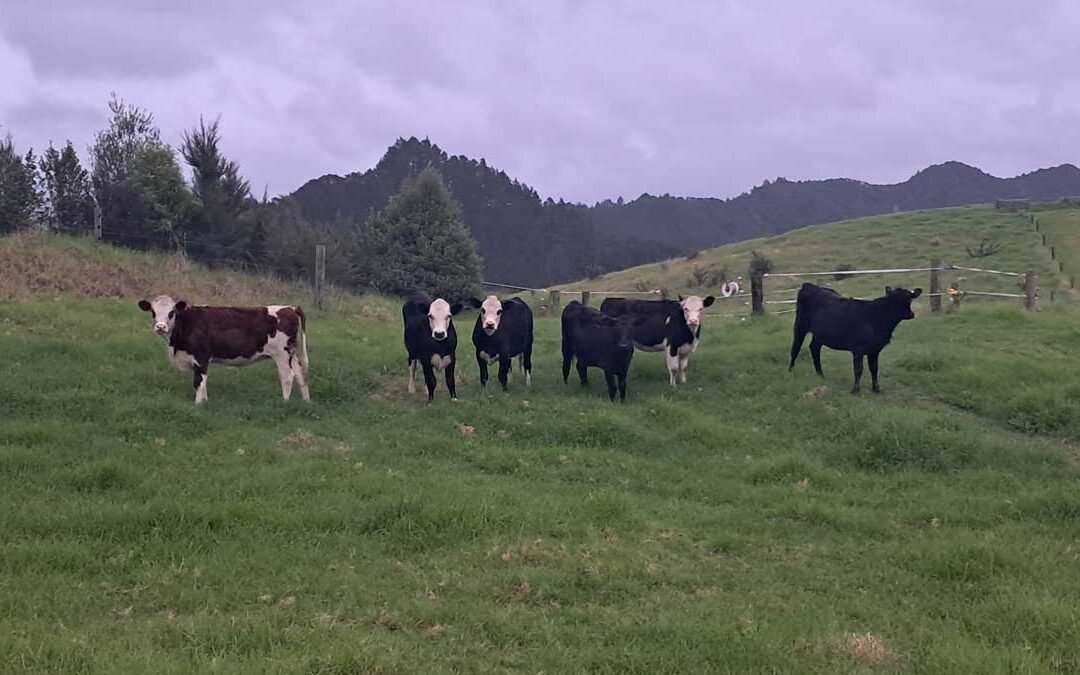
At 3pm on a Wednesday afternoon, I got off the strangest phone call.
That phone call cost us over $5,000; so it wasn't a particularly cheap phone call. But we'd just bought some new cows. Apparently.
I hadn't quite planned to spend that much on our replacements, but we did have $5,500 tucked away in a savings account from our last payout for this purpose. So we decided to take what we were given.
The phone call
Our stock agent had rang out of nowhere to say "I've just bought you 6 heifers, they got passed in and were a really good price."
Reader, I had not instructed this man to buy our cows yet. Richard and I had been warned the price of young cattle had risen sharply and we'd thought we'd head to the sales ourselves in a week or two to see by how much. But we had asked our stock agent to look out for a bargain for us during his last visit.
"What kind of price?" was my question.
"Four at $870 and two at $970" was the answer.
If I had been drinking anything at the time, I would have spat it out. That did not feel like any kind of bargain at all based on our previous experiences.
The twist? Four of them weighed 190kg, and two of them weighed 235kg. They were significantly larger than our usual arrivals. There's an extra 8-12 months of growth on them. We can turn them around faster. Get the next payout sooner.
Assuming there isn't a crash in commodity prices in the next 12 months (never guaranteed), it was a good deal.
Our stock agent hadn't steered us wrong once in our 6 year relationship, so we took it. They would be arriving in a few hours.
I hoped they'd be fence trained.
3 hours later
Our neighbour (who lives closer to the communal stock yards than we do) sent us a message to tell us a stock truck had arrived and was unloading.
We quickly shovelled down the last of our dinner; put our gumboots and headtorches on; locked the dogs up inside; and ran out the door.
All the equipment we'd need to move them was still in the car from sending off the last load of cows, our own laziness working to our advantage. We flicked on the electric fence in our 'house paddock'—the one surrounding our little compound—and drove up to get them.
It was just getting dark. As I peered into the stockyards I saw what looked like 3 black Herefords, a brown Hereford and two Angus cows in the light of my headtorch.
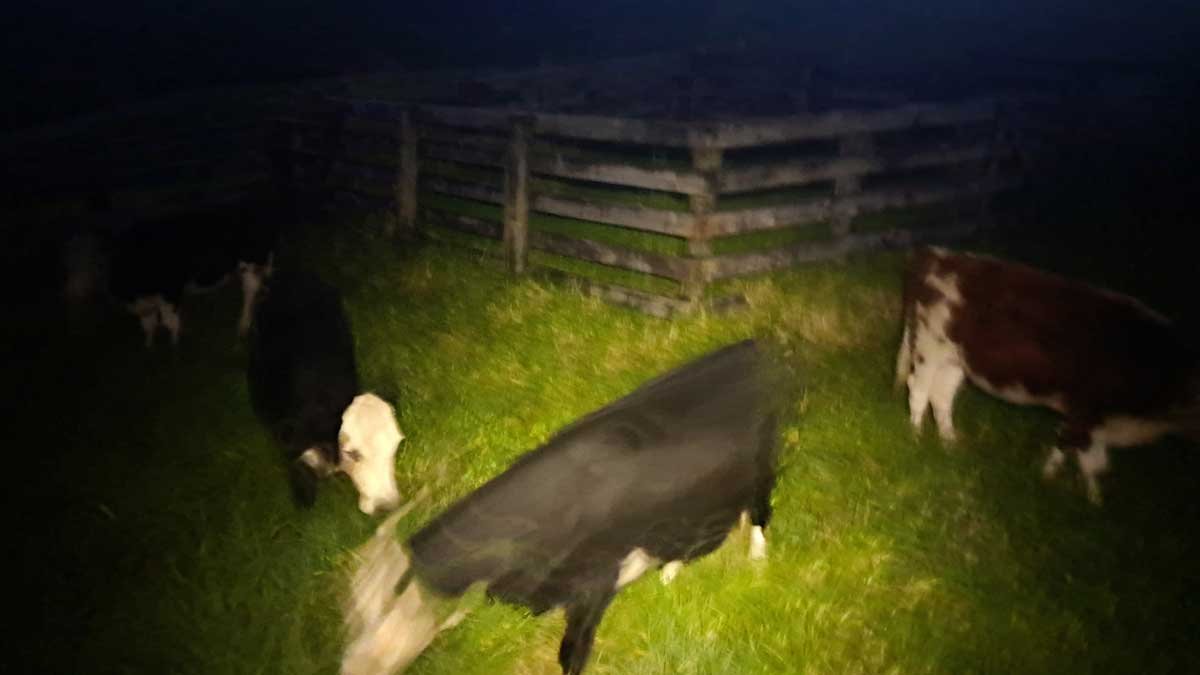
This photo in-part so terrible because they were furiously shoving grass into their mouths.
Reader, these poor girls were hungry. They'd been at the sales all day and were going hard mowing the grass inside the yards.
Richard and I introduced ourselves and said hello, then we came up with the plan to get them home.
"It's almost like we've done this before"
We wrangled them out of the yards and then almost lost them down to the neighbour's place. But this wasn't our first rodeo, we'd already closed our neighbour's gate because cow, humans... everyone tends to head towards his place when they don't know where they're going.
Richard pushed them back up while I waited up the top to turn them around in the right direction. And then we were off. Six little cows trotting along, followed by one very slow car with the high-beams on.
Richard was leaning out the window telling them to turn right or left while I tried to get an arrival photo in the fading light. Yes, we really are this ridiculous.
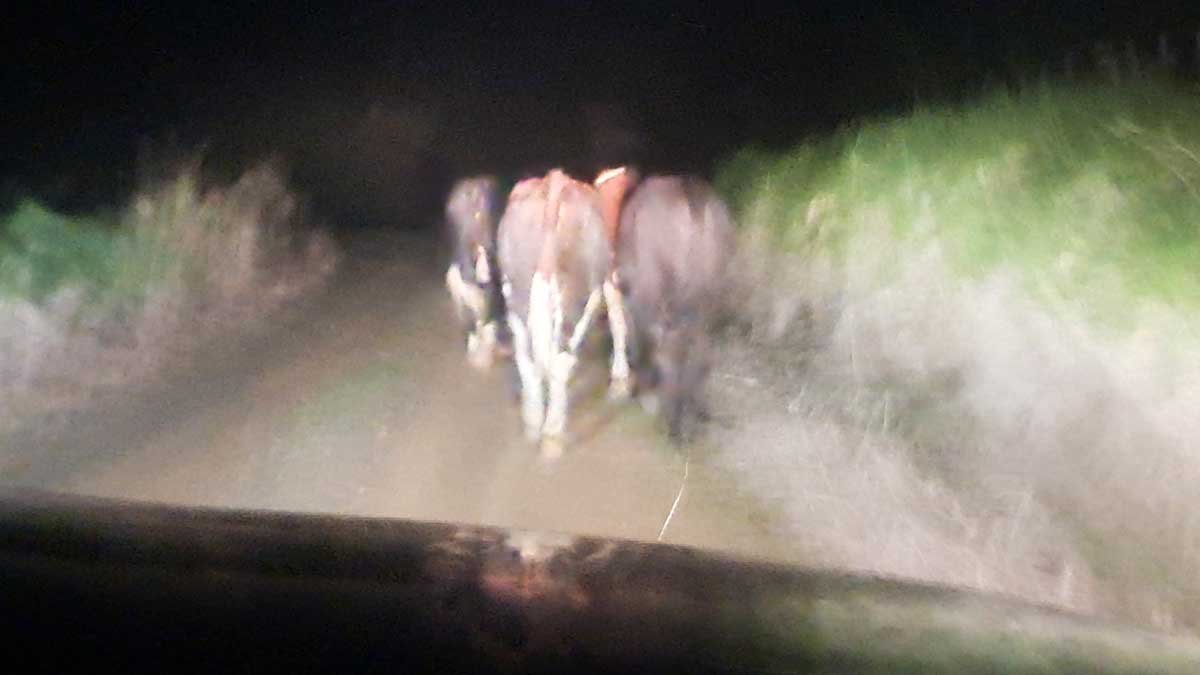
It's about a kilometer between the communal yards and our property, but we made it with no major incidents and all six of our new girls. We let them trot down the driveway while we closed our own gate and re-opened another neighbour's.
We'd hoped they'd find the paddock, but as we approached where we'd thought they'd be, they weren't there. They'd crashed right through the tape we'd set up and had found the patch of grass at the top of our race.
Thankfully I'd been in the habit of closing the gates up there on our rehabilitation walks with our dog Roxy, so they hadn't gone any further.
Richard went around to push them back down, while I waited below to guide them into the right paddock. As they went in, I counted the glowing eyes in the beam of my headtorch. Six sets of eyes.
Six new surprise cows now safely contained in a paddock with access to water and grass. Job done for the night. We breathed a sigh of relief. This gets easier each time, but it'll never be easy.
The next morning
I woke up and checked my phone. There was a NAIT message in our inbox: "movement to confirm". This is where we find out what we've got. Kinda.
If a farmer is birthing hundreds of calves, they don't really have a lot of time to put a lot of detail into a cow's NAIT information. That was the case with these ones. Some of them had only been tagged the morning of the sale.
It looked like four of them had come from near Kaitaia. Exact birthdate unknown, but probably around April-May 2025. The other two appeared to have originally come from Kawakawa, born April 2025.
That told us how long they'd likely be with us. It looks like they have about a year here.
Good to have a bit of a plan for one's surprise cows.
The new dawn rises
As the early light began coming through the windows, I popped on my gumboots and went to find them. I really wanted to know how friendly they were. I'd got the feeling that the Herefords might be approachable, but maybe they were just really hungry.
With a night to settle in, drink water, and eat their fill; we might be able to start learning their actual natures. This is the key bit. I don't mind paying for good cows. But our third herd taught us that cheap cows sometimes come with a behavioural caveat.
The third herd were cheap, but they cost us a small fortune in fence repairs. Being quite small when we got them, they figured out every potential gap in our fences early, then they kept using them their whole lives. We spent way too much time chasing them around the countryside.
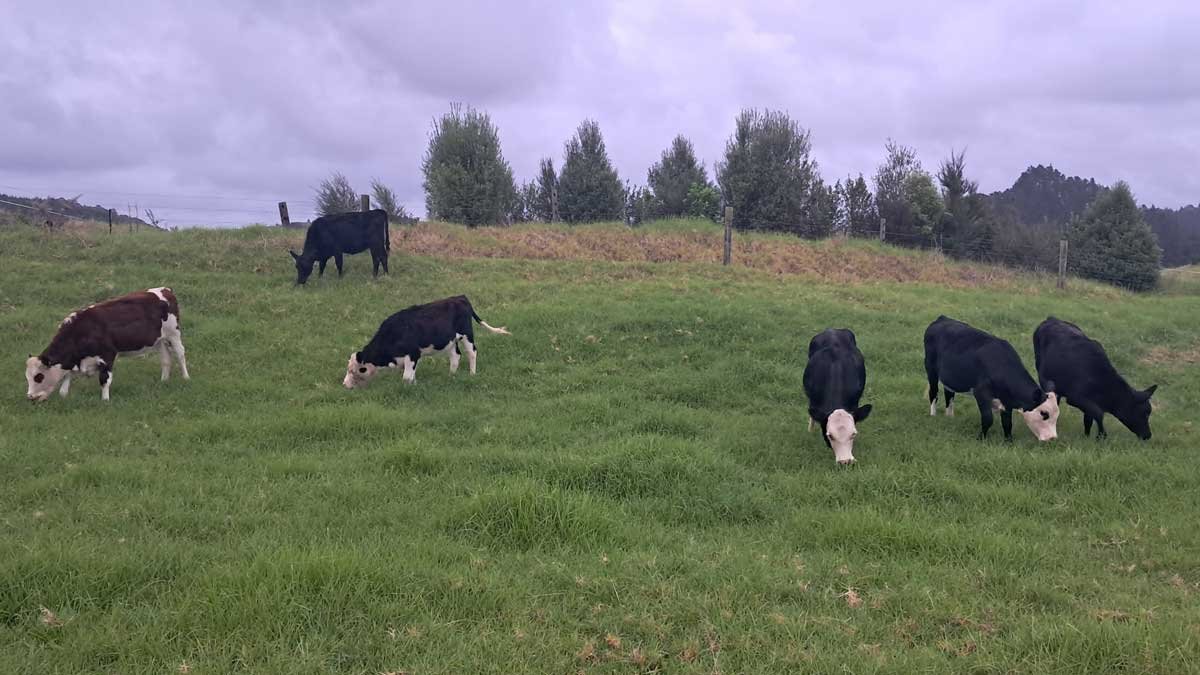
The surprise cows are our fifth herd. Our fences are in much better shape overall after the repairs, and the paddock they were placed in is our most-secure. But you never quite know 'til you know.
At first they ran away from me. Then when I tried again, they let me get pretty close, but they weren't approaching.
For the first few days they stayed mostly at the top of the paddock, where they weren't anywhere near us and could 'hide'.
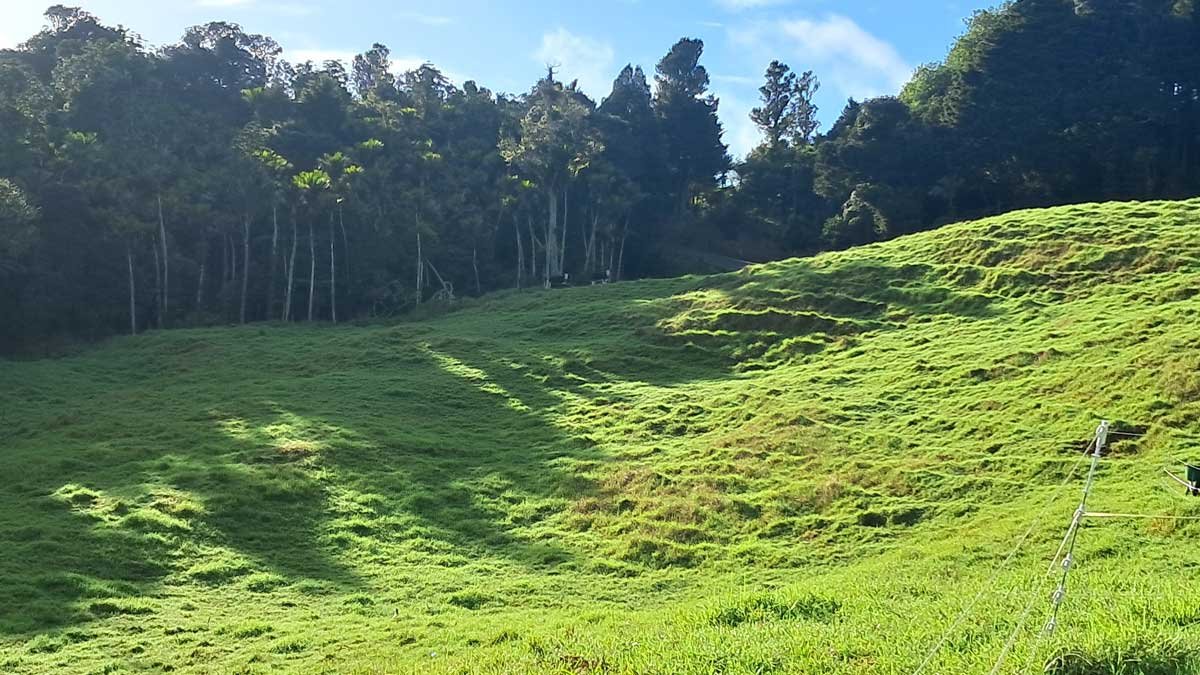
Look close and there are two white faces under the trees.
I put a salt block by the trough at the opposite end of the paddock. Salt blocks are a bit like cow treats. They love them. And they provide a bunch of missing minerals they can't find in our pasture. I figured they'd have to seek out water eventually, and when they did, they'd find my peace offering.
Slowly, they started coming down into the main paddock. Like every herd of cows we've ever had, they are fascinated by the cats.
They got introduced to the whole family—our dogs Roxy and Hine; our rooster Tommy, his sister Pam, and the other chooks; as well as Sabre, Patu, and Samurai, the fascinating cats.
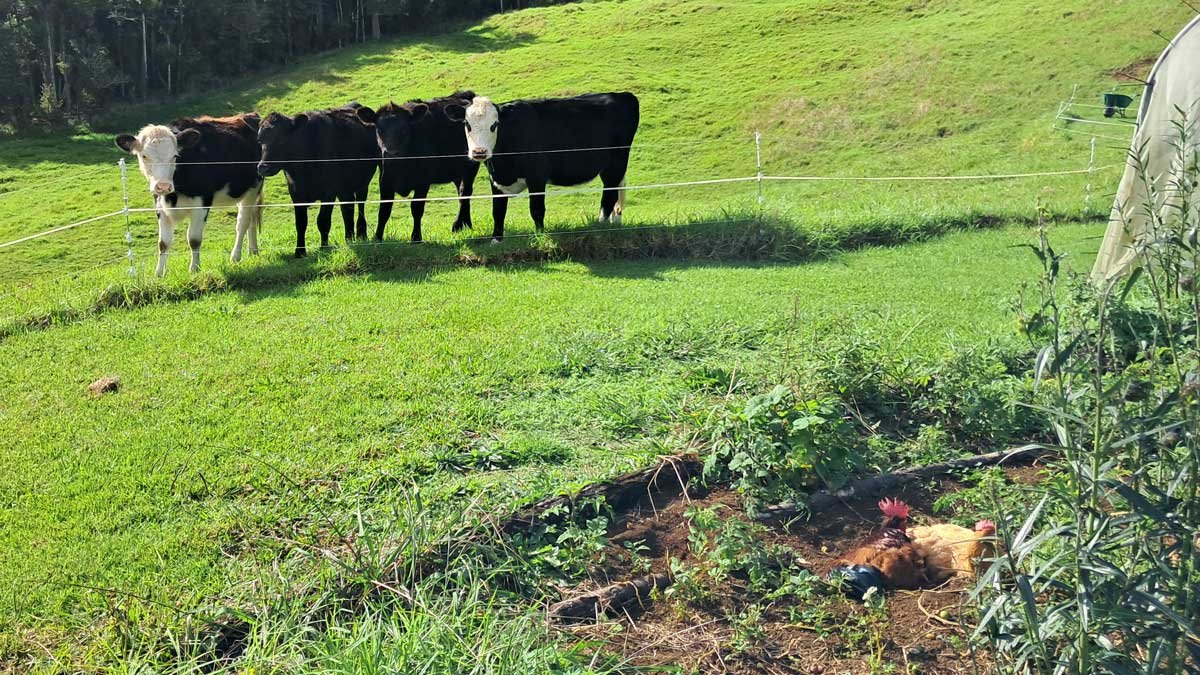
While weeding the garden, I noticed I had an audience, who were watching both me, and my dust-bathing chickens.
We started to see the cows a bit more. It's going to take time to build this trust, but we'll get there. It's a bit wet and cold for the banana leaves, but I've never met a cow that doesn't love them.
The bill arrives
I had coffee with a friend who owns cows and she told me she was paying those prices for much younger calves. Another friend's experience concurred. We'd done quite well.
The $870 and $970 figures didn't include GST or any of the various fees associated with buying cows. It also didn't include delivery.
We had just enough in a savings account to cover the base cost, and maybe we should have gone for 5 cows again. It was a bit of a scramble to pull the rest of it together again amongst other bills, but we managed.
So given I had a handy little table in my last post about the payout, let's do a table in this post related to the cost of buying a cow from a saleyard using an agent.
| Herd 2 | Herd 3 | Herd 4 | Herd 5 | |
|---|---|---|---|---|
| Year purchased | 2021 | 2022 | 2024 | 2026 |
| Number of cows | 6 | 6 | 5 | 6 |
| Age | 15 mo | 4 mo | 6 mo | 9-12 mo |
| Average weight | 220kg | 95kg | 155kg | 205kg |
| Price paid/kg | $2.18 | $4.42 | $3.68 | $6.91 |
| Average price/head | $480.00 | $420.00 | $570.00 | $903.00 |
| GST/head | $72.00 | $63.00 | $85.50 | $135.50 |
| Associated fees/head | $4.83 | $4.88 | $8.34 | $8.52 |
| Delivery | $124.2 | $119.85 | $116.13 | TBC |
| Total paid | $3,465.19 | $3,047.18 | $3,435.32 | $6,284.07 |
| Average paid/head | $577.53 | $507.86 | $687.06 | $1,047.35 |
Notes: In this table, I haven't included our first herd because their cost was included in the price of the property when we purchased it.
Herd 2 were an absolute bargain, picked up quite skinny in a drought year.
Herd 5's age is partially an estimate as some of their birthdates were unrecorded. The bill for their delivery also hasn't come in and I'm interested to see what it's like with the fuel differential at the moment. I'll update this after it arrives.
Average price/head is before GST.
Delivery is in total for the herd, including fuel differentials and GST.
Total paid includes purchase price for the entire herd, stockyard fees, delivery, and GST.
I guess this goes some way to explaining the price of beef in the supermarket at the moment too. Cows are just significantly more valuable than they were 6 years ago.
Things have changed. We felt that signal last time we purchased a herd, and we're feeling it again.
With the bill came the knowledge that two of the white-faced black cows were the heavier, more expensive cows. The rest were chosen by our agent out of a larger herd.
I like that our cows 'match' to a certain extent. I think he did that on purpose.
Richard and I had both wondered about those cows because they distance themselves within the herd, sticking together often at the edges. They also seem to be more approachable. But it wasn't until I had the full paperwork that I could confirm that.
Risky business
In my Mother's Day post I wrote about my great-great grandmother who found herself in charge of the family farm and thousands of animals in the middle of the Great Depression when commodity prices tanked.
And honestly, right now that feels like a risk. Every investment comes with a risk. Cows have been a pretty safe bet for the last 6 years, but this round makes that risk feel even higher. We're gambling that 12 months from now, the payout will still be worth this price.
It's worked out in our favour every time before now, And it's likely it will work out again. The payout would have to be much lower than anything we've seen before in order to actually put us in the red.
The lowest price we've seen was $5.30/kg in 2020. At that level of pay-out, we'd have an after-tax profit of about $200/head. Prices would have to fall closer to $4.30 before this purchase begins to actually lose us money.
If payouts happen to stay closer to the $9 mark where they are right now, we'll be fine, this will balance out. It probably doesn't help from a consumer point of view, but it does make the effort of raising them worth it.
Time will tell. In the meantime, we'll adjust, welcome these girls to the farm for the next wee while, and see what happens.
READ NEXT
The price of beef
After sending off our last herd I wondered about the giant leaps in the payout from processors.
READ NEXT
Fencing folly
The work created by a herd of cheap cows was not insubstantial.
Related content: #chickenfarm · Angus · animal tales · breeding · cats · cattle · cost of living · cows · dogs · fences · fourth herd · heifers · Hereford · lifestyle block · NAIT · Northland · Richard · rural economy · rural life · salt · stock agent · the family · The Outpost
Stay in touch?
The Kat's Garden newsletter gives readers an extra peek behind the scenes. It's the best way to know when new posts go live, and what's happened since.
If you like what you've seen, join us and see what we learn next.