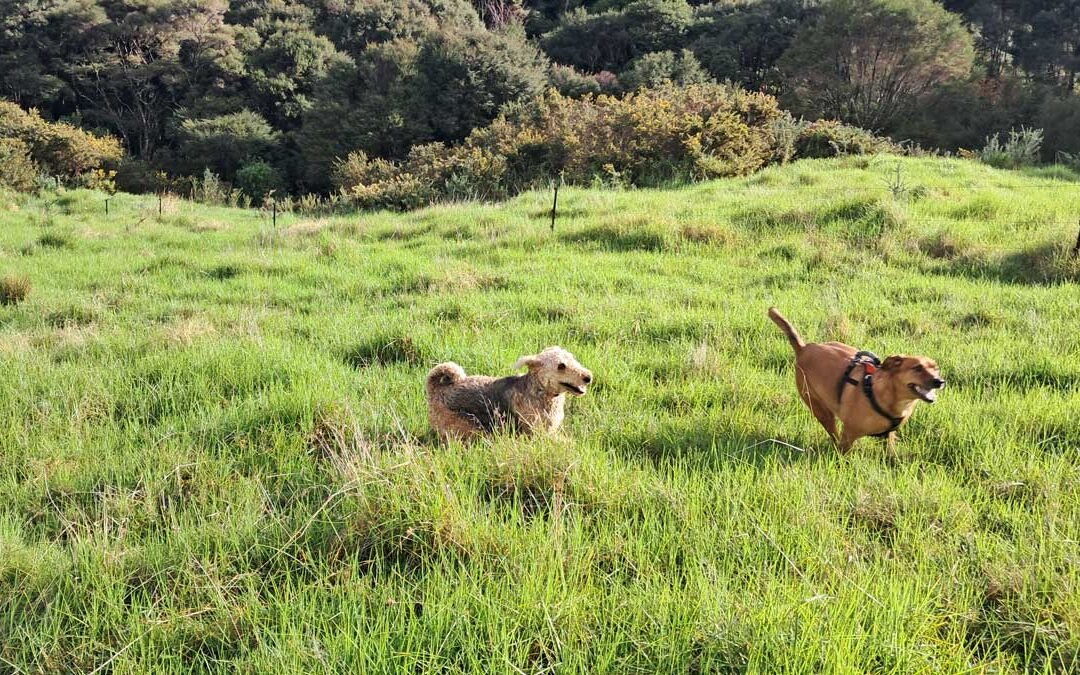
Two years ago I announced a big fencing project, and then... I just never wrote about it again.
It didn't mean the fence project itself got abandoned. Quite the opposite actually. We did a job that has held up quite well since then.
I even wrote a post about it—this one. It's just been languishing in my 'Drafts' folder for the last two years.
More recently, it turns out this fence is an important step towards a project we're working on in winter 2026. If I'm going to take you on that journey, it would probably help to have this piece of it.
So here it is, the lost fence post.
Cast your mind back...
It's 2024. While clearing gorse off fence lines in "Paddock 2", Richard and I discover a few sections where the land was simply eroding away under the fence lines, leaving big gaps.
The simplest path forward was to cut off a fairly significant patch of grazing to create a straight-ish line that ran closer to the actual boundary of our property.
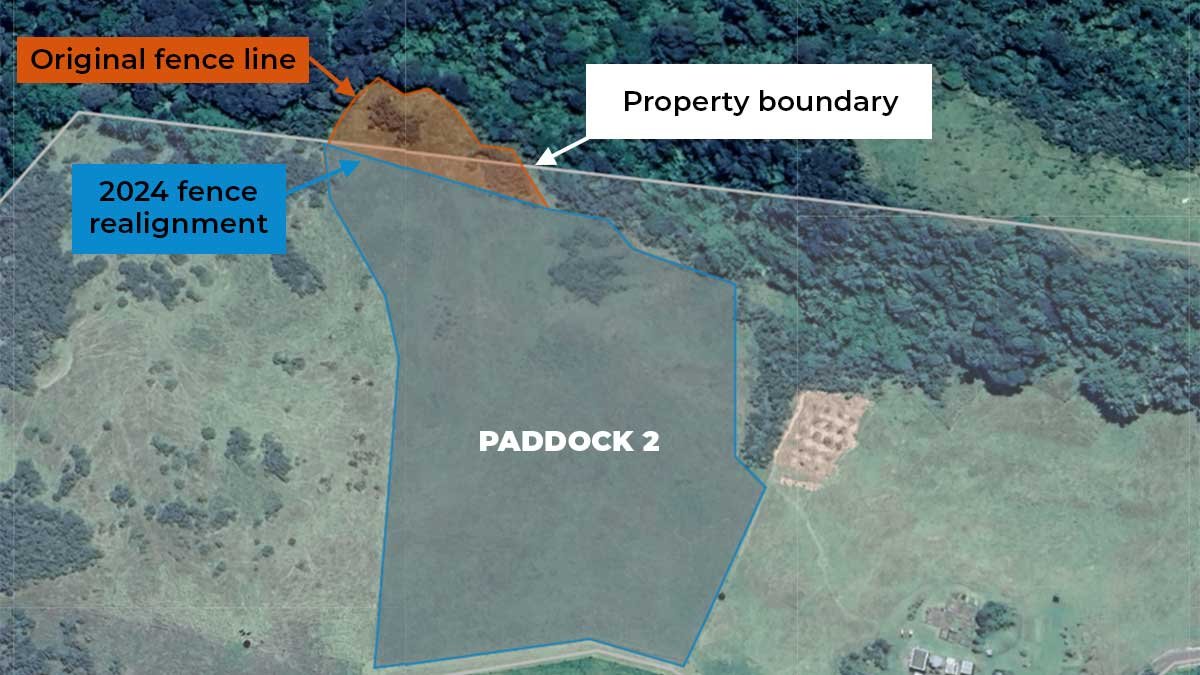
The eroding section technically belongs to a neighbour, but it's only practically accessible from our side.
We checked in with them and they were happy for us to just let it go to eventually regenerate. We were happy to be rid of a problem that wasn't technically ours.
Planning
It always looks so easy when you're looking at a flat map on a screen. But it's a different story when you're on the ground.
On the ground, it turned out there were some large gorse bushes interrupting my straight line. There was also a hill that made getting that angle exactly right really difficult.
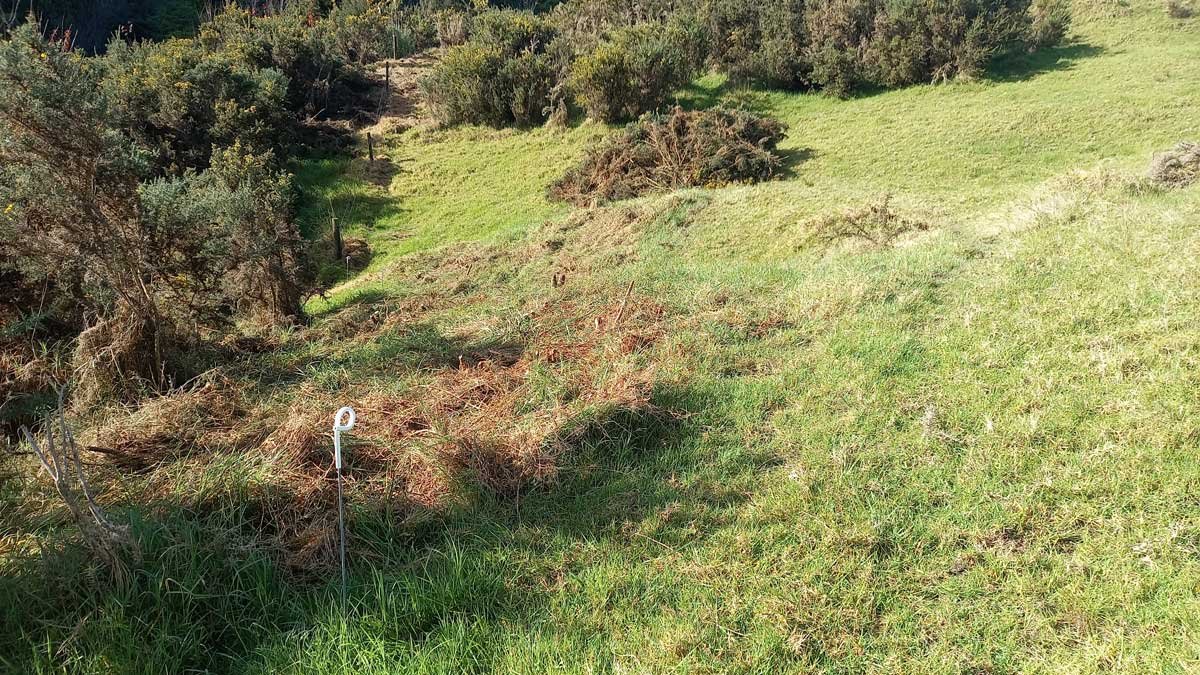
It took days to clear the gorse. The photo above is the pile of gorse I cut at the time in the background in the center of the frame; and the area I cleared it from on the left in the foreground. The white 'pigtails' show where the new fence line runs.
Then there was another day of walking back and forth, up and down a hill, to get our line as straight as possible using pigtail stakes and tape.
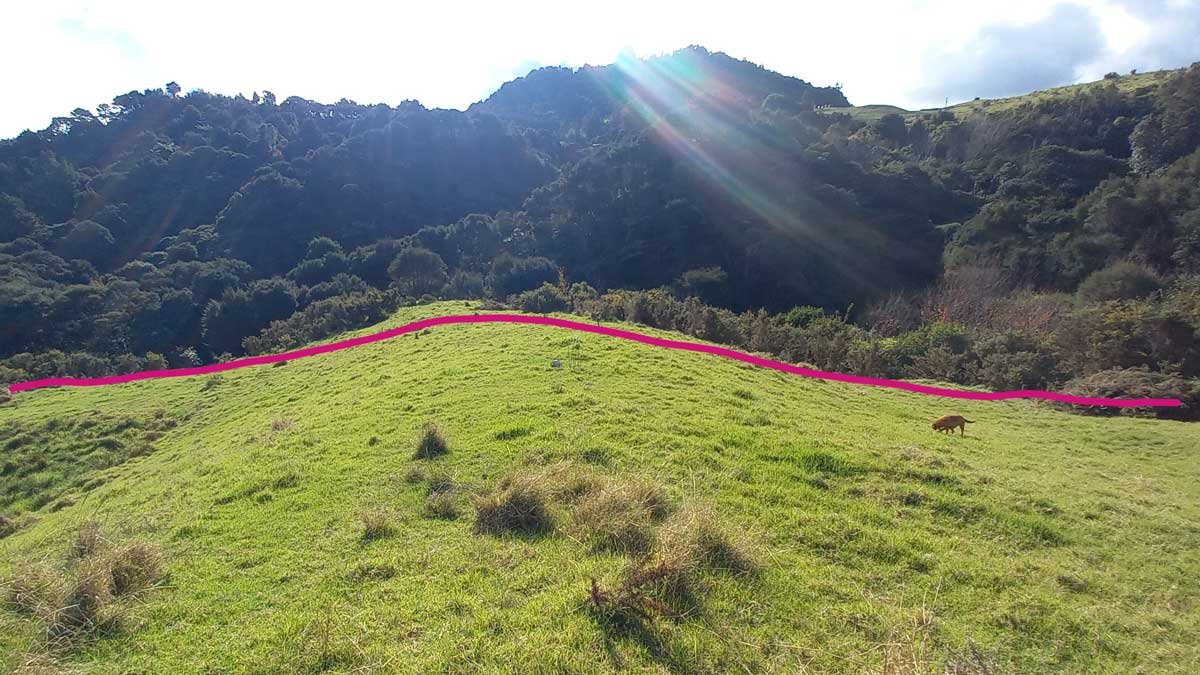
But eventually after a lot of fiddling, we had a mostly-straight line marked out with the temp-fence.
Semi-permanent
There are many different ways to erect a fence.
We decided to re-use the wire that was already there, and just redirect it to the new line. But we still needed to make a call about the posts that wire would be attached to.
We decided to use steel Y posts (warratahs). These are a reasonably cost-effective option which we are able to lift and re-use in the future if we want to. They take 5-10 minutes each to bang in—a job for which we already had all the important tools.
The former-owners of the property had used them in a few places, and comparing them to the various grades of fencepost on the property, they were holding up quite well.
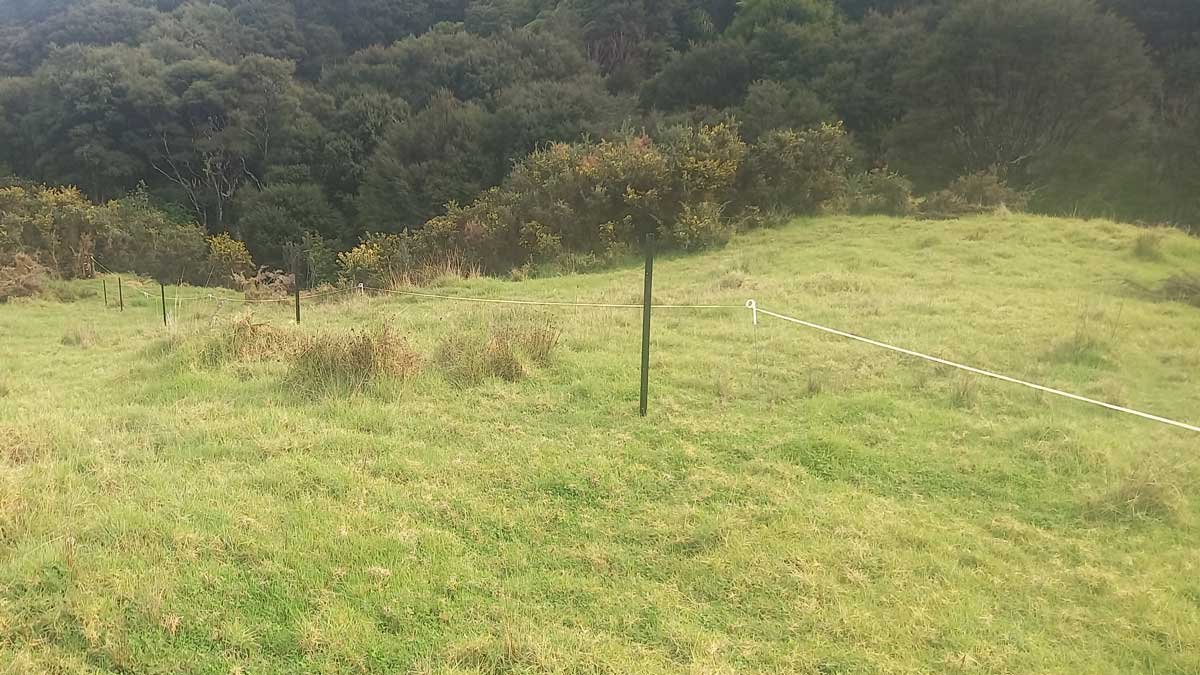
We can always upgrade them further down the line as we solidify the plan for this area of the property, perhaps after a survey to find the actual boundary.
String the line
Before the wire could be put along its new route, it needed to be pulled off the old one. Turns out, that was easier said than done.
Even though it had been stretched straight for at least a decade, as soon as we started pulling the wire off, it sprung back into a spool.
Not a nice neat spool—a tangle of number 8 wire that needed to travel over a section of freshly-cleared gorse stumps before being un-tangled and re-directed.
There was lots of walking up and down hills at this point as we took the wire off the original posts and re-attached it to our Y posts. There were many, many tangles to disentangle and snares to unsnarl.
It took us a couple of days of solid hard work amongst mud and gorse, but we got there. The three wires were put on their new route, attached to the Y-posts with insulators, and tightened up.
The new route is shorter than the old one, so we cut the excess wire and brought it back up to the compound for future projects.
Farmer Kat
Honestly, I don't think I could have imagined this life in my younger days. If you had told me while I was in my early 20's that I'd be spending my 40's arguing with Number 8 wire, I would have been so confused.
Here now in 2026, our new fence has held up well over the last couple of years. We've kept on top of the gorse, there's no more erosion happening underneath the fence line itself.
But more recently on our rehab walks with Roxy, we noticed a fence post that was definitely straight two years ago, now sitting on an odd angle. Things had changed in a concerning way.
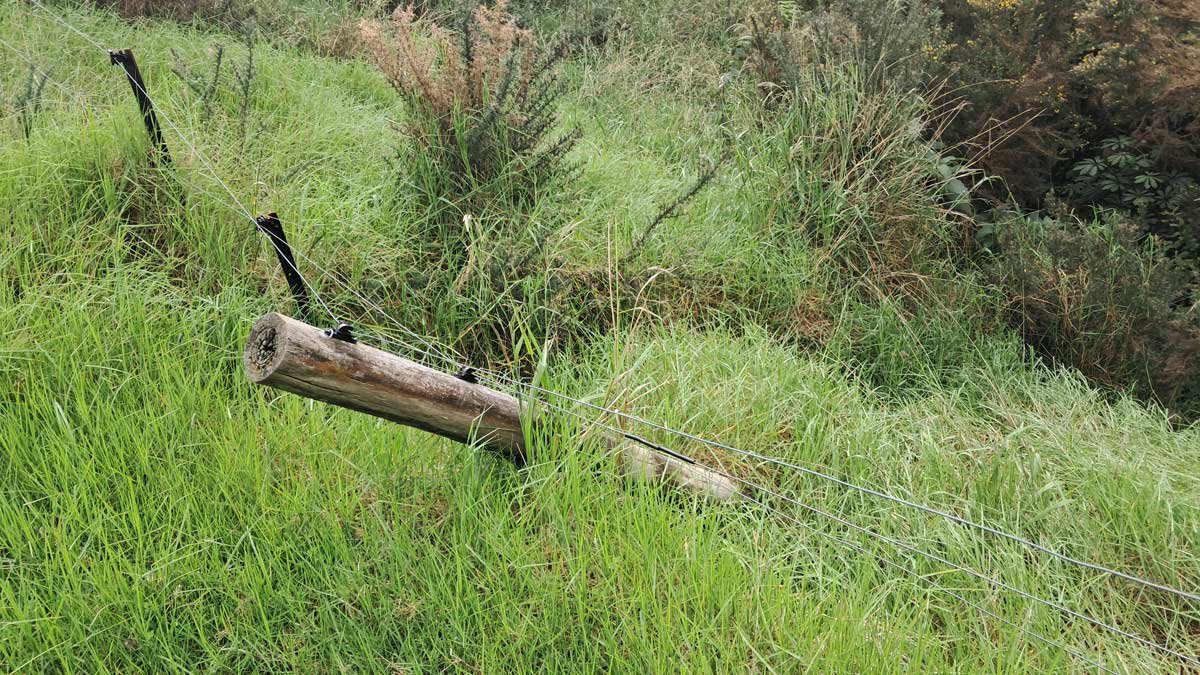
It's looking a lot like we need to retire another section of this paddock.
But that's a post for another day.
READ NEXT
Sweating with Pride: The fences project
Where we last left off, back in 2024, in case you'd like to go back.
READ NEXT
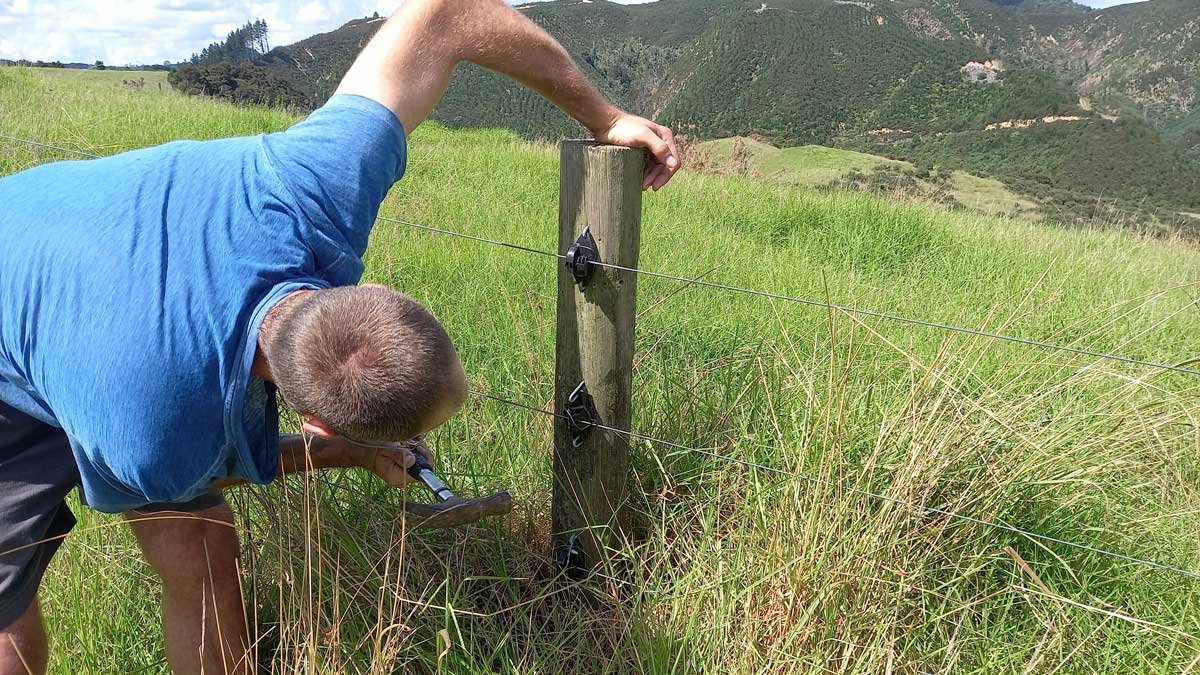
Fencing folly
The real beginning of the problem: 2022, when a new herd of cows just refused to respect our fences.
Related content: cows · diy · drainage · electric fence · erosion · fences · gorse · lifestyle block · native plants · neighbours · Richard · Roxy · rural life · soil · The Outpost
Stay in touch?
The Kat's Garden newsletter gives readers an extra peek behind the scenes. It's the best way to know when new posts go live, and what's happened since.
If you like what you've seen, join us and see what we learn next.