
Richard and I love growing potatoes. We love eating potatoes. They are like magical tasty gifts from nature when you pull them up out of the ground.
Harvesting spuds is one of our favourite jobs on the farm. Which is good—we grow a lot of them, and for the last few years they've become weeds which also grow themselves.
Potatoes can be grown in containers, special grow bags, or in the garden. You can buy special certified seed potatoes, or you can plant whatever is sprouting in your cupboard.
Sometimes things go wrong. But often, even when they do, you usually still have potatoes.
In my opinion, they're the greatest vegetable to grow in your home garden.
Can you use any potatoes for seed?
To grow potatoes, you plant a potato. This is a 'seed potato'. Any potato can be planted in the soil and grow more potatoes.
Certified seed potatoes from a garden store are more expensive than consumer potatoes from the grocery store. But they also have very low risk of carrying disease. That's what the 'certified' means.
The potatoes sprouting in your pantry will grow and produce more potatoes if you plant them.
The catch is they may be harbouring disease. If you bring a disease into your garden, you're probably never getting rid of it. This is one of the (horticultural) lessons that came from the Irish Potato Famine.
Ultimately, it's up to you whether you run this risk. For years, I purchased seed potatoes. I've never planted one from the supermarket. The Irish Potato Famine was part of my School Certificate history curriculum, and I guess that lesson stuck.
These days we run more of a 'closed loop' system. We save and re-plant our own potatoes. So they aren't introducing anything new at all.
After years of playing with varieties, there's now a bit of a feral mix of Rocket, Apache, Agria, and Desiree throughout the garden.
These days, whatever's sprouting in storage at planting time is what gets planted for the next year.
Purchasing seed potatoes
When we purchased seed potatoes, we always harvested back at least twice the value of our initial spend. On a good year it could be more than five times the value.
In fact, even with the outlay on certified seed potatoes, I've always felt potatoes are one of the best crops for ROI in our garden. Now that we're running closed-loop, that value is only getting better.
You can pick up seed potatoes from May to October (ish) in your local garden centre. Big box stores will sell 1-2kg bags, while specialist garden centres may sell them individually. Farm stores may carry 5-10kg bags.
It can pay to get in early if you want a more popular variety like Jersey Bennes or Agria.
Choosing a potato variety
This is maybe the most confusing part of the process.
When you go to the garden centre to buy your potatoes, you might see a chart that tells you about them, or you might read the pack and think 'there's a lot of jargon here'.
In New Zealand, seed potatoes can be classified as 'early', 'second early', or 'main'. Additionally, they're either 'floury' or 'waxy'.
So let's break the terms down.
Early and second early potatoes
These are the first spuds you can get in the ground after frosts have passed. They have a slightly better cold tolerance (though no potato will survive a frosty morning).
Early potatoes won't store well, but they can mature fastest (Rocket and Swift varieties can mature in just two months). They tend to be harvested and cooked on the same day as 'new potatoes'.
Popular early varieties include Jersey Bennes, Liseta, Cliff Kidney, Rocket, Swift, and Maris Anchor.
Second-early potatoes will store for a short period.
Second-early varieties include Nadine, Purple Heart, Red Fantasy, Haylo, and Ilam Hardy.
Main harvest potatoes
These are the spuds you grow to store indoors and eat over winter. They'll take longer to grow (3-4 months), and it's usually better to plant them a bit later.
I aim for mid-late October, with a second round going in around January. But if you live in a region with shorter warm periods, main crops can be planted at the same time as your earlies.
I find that the main harvest potatoes planted later in early-mid summer produce way more potatoes. I put it down to the soil being nice and warm. But I say that as someone with the privilege of a long warm period for them to grow through.
Popular main varieties include Agria, Rua, Desiree, Red Rascal, and Van Rosa.
Waxy vs floury
When I worked in a garden centre, I used to help people choose their seed potatoes. My first question was always "how do you like to eat potatoes?"
There's no point growing a spud you don't want to eat, and we all have our preferences on how to cook them. This is the factor that influences whether you want a floury potato, or a waxy potato.
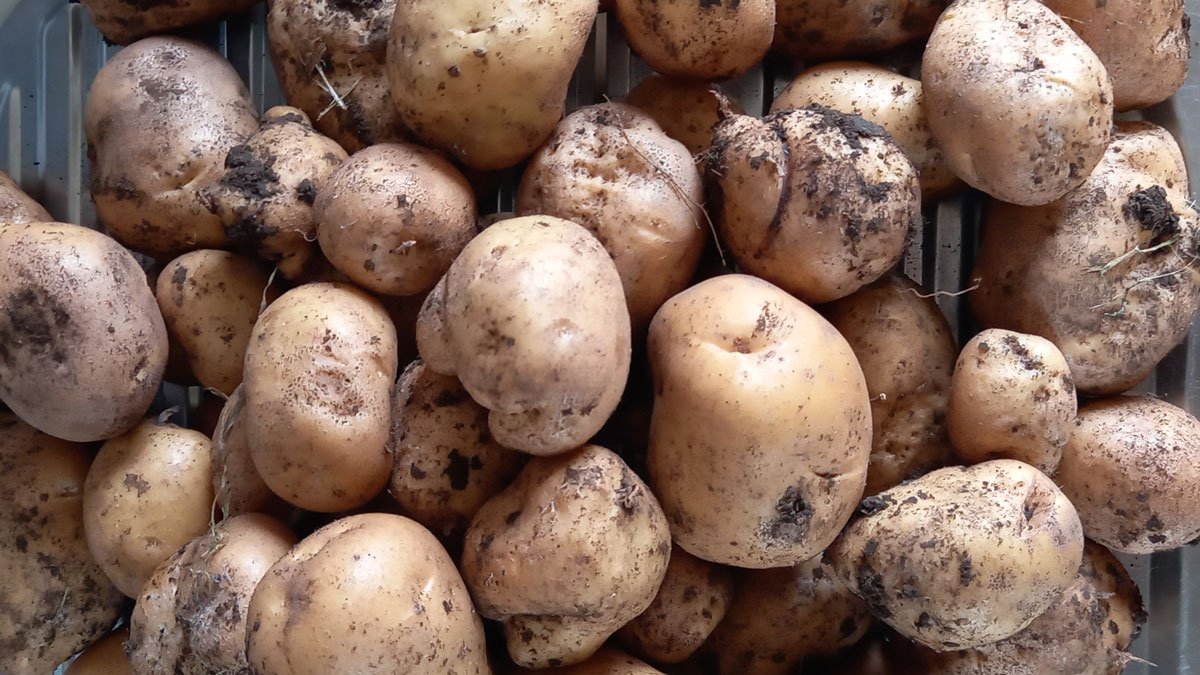
Floury (or 'starchy') potatoes go "fluffy" and fall apart on cooking. When cooked or exposed to water, the starch cells expand quickly, breaking down the surrounding cells. That's what makes them great for mashing, roasting, chips, and baking.
Popular floury potatoes include Ilam Hardy, Karaka, Agria, and Red Rascal.
Waxy potatoes hold their shape when cooked. They contain less starch. They're best for potato salad, casseroles, boiling, or anything else where you don't want your spuds crumbling to pieces.
Popular waxy varieties include Cliff Kidney, Jersey Bennes, Swift, Nadine, and Rua.
All purpose potatoes fall in the middle and can be used for a range of final uses. Good if you have limited garden space and a wide variety of potato-favourites. But they're not going to do either function quite as well as a more 'specialised' potato.
All purpose potatoes include Liseta, Haylo, Red Fantasy, Moonlight, and Van Rosa.
Taewa (Māori potatoes)
Taewa are potatoes grown by early Māori, and passed down to today.
They are closer to the original potatoes that came out of South America than the 'table potatoes' discussed above, which have been bred for starch content, size, yield, and disease resistance.

Seed potato display in a store
Breeding programs aimed at keeping taewa varieties alive mean that a wide range can be found easily on garden centre shelves.
However, they haven't had much pest-resistance or productivity bred into them. That means they can be more temperamental to grow than the more modern commercial varieties.
Best planted in late spring, they can take longer to grow than commercial varieties as well.
But the results can be varied, unique, and (most importantly) delicious. Varieties include Kowiniwini, Urenika, Huakaroro, and Moemoe.
Nick Roskruge from Tahuri Whenua has spent years researching and writing about Māori crops.
I highly recommend his books if you want to learn more about growing taewa.
How many seed potatoes do you need?
It depends on how many you eat, really. We are a potato-heavy household of two and we stopped buying spuds altogether a few years ago.
To do this, we started the season with about 3kg of an early crop. I love the flavour of Jersey Bennes, but the one which has gone feral for us is Rocket. I can tell them apart from the Agria because the flesh is white, rather than yellow.
Because I live in Northland, I usually got these in around July (and protected from rogue frosts by having a big stack of grass mulch on hand).
This crop usually began producing new potatoes when our stored spuds ran out (around September), and continued to supply us until our main harvest was ready.
Next up, we planted another 3kg of Agria and Desiree in mid-late October, then repeated it in January.
This often returned us over 40kg of potatoes.
These days, the feral potatoes growing like weeds throughout the garden tend to replace the early crop as I undertake the annual winter garden tidy-up.
We've replaced the October planting with our kūmara, but we still put in one very big mixed-up planting in December-January. I usually sow about 4-6kg of whatever's sprouting.
We cure and store the summer harvest to get us through winter.
Chitting potatoes
"Chitting" means to let the potatoes start to go green and grow sprouts.
This gives them a head-start when you plant them, and reduces the chance they'll just rot in the soil.

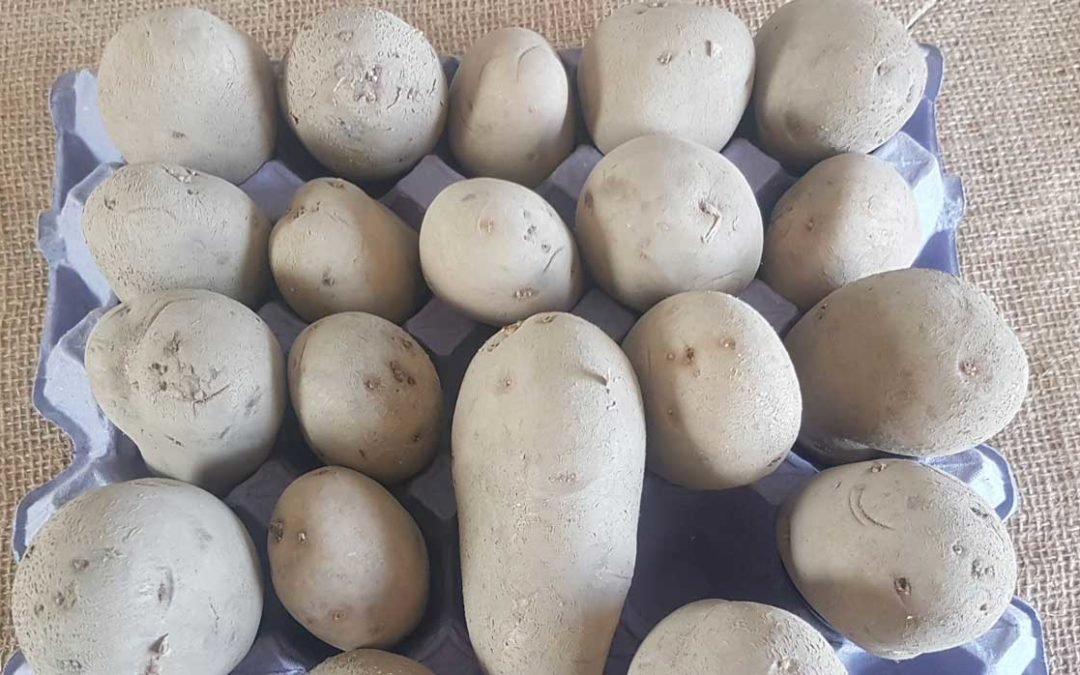
The 2021 Agrias set out for chitting.
Keep your seed potatoes somewhere they are dry, but exposed to indirect sunlight. Chitting will take about a month.
I place my planting potatoes in egg cartons. This keeps air circulating and mostly prevents shoots being accidentally knocked off.
I've found rotating the potatoes about once a week helps to develop more shoots as they seem to prefer to shoot on whatever side is pointing up.
Your seed potatoes are ready to plant when your sprouts are 1-2cm long. Check out my post on planting potatoes to learn more about that.

READ NEXT
Planting potatoes
Now that you've selected your potatoes and got them set out to chit, what's next?
READ NEXT
Harvesting and storing potatoes
You grew potatoes! How do you harvest them and store them to eat over winter?
Related content: Agria · chitting · Cliff Kidney · Desiree · gardening advice · Haylo · how-to · Jersey Bennes · potatoes · rocket · seed potatoes · taewa
Stay in touch?
The Kat's Garden newsletter gives readers an extra peek behind the scenes. It's the best way to know when new posts go live, and what's happened since.
If you like what you've seen, join us and see what we learn next.



I took 6 sprouting spuds and sneeked them into the far end of the community garden in my retirement village. They came up and the person in charge of the garden spotted me checking them out and gave me a right bollocking for planting them with out his permission. I apologized but he left them growing. They flowered and died back. I search thru the soil and found a dozen small spuds. I enjoyed them but I must have missed a few so every year new plants grow. Someone else harvests the spuds but that fine by me.
Haha, oh dear, people (including myself) can get right territorial about gardens huh? Yeah if you missed any, they just kind of naturalise and become ‘feral spuds’. Best weeds in the garden in my humble opinion!