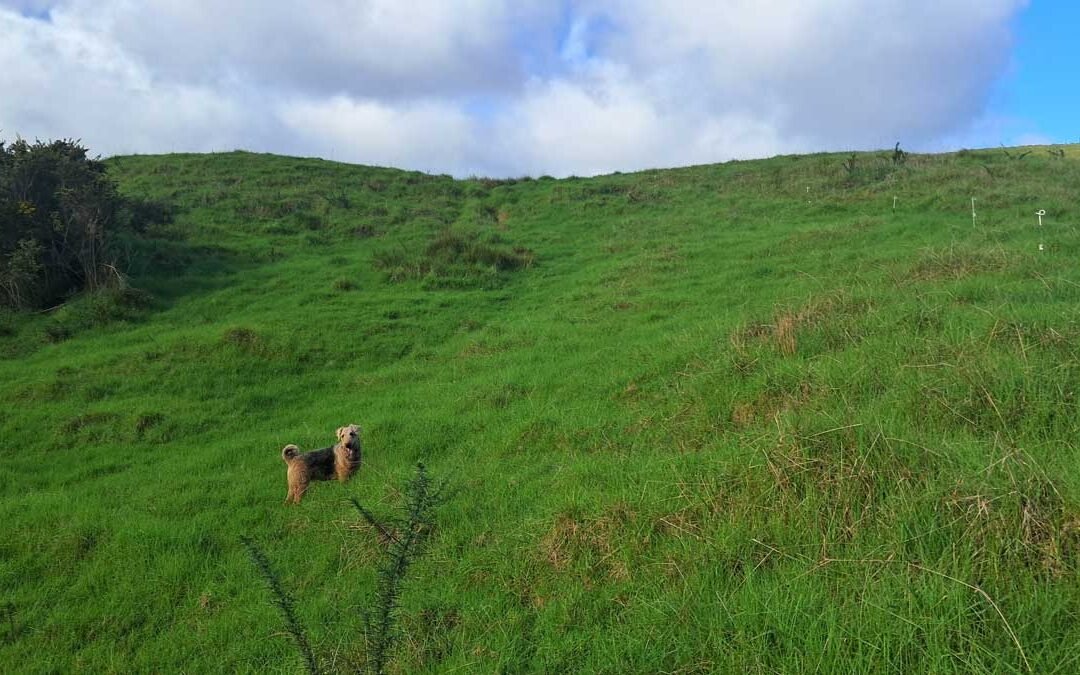
Two years ago, Richard and I put some sweat equity into cutting gorse back off the fences and repairing the faults to better-contain our livestock.
As we worked, we noticed several areas in "Paddock 2" where the ground beneath the fences had eroded badly enough that we decided to retire a section.
Given that piece of land technically belonged to a neighbour, we shifted the fence back to our side of the boundary. We hadn't had a lot of problems since.
Until we began taking our dog Roxy for some longer walks around the boundary as part of her rehabilitation.
We noticed one post had shifted significantly after the summer deluges.
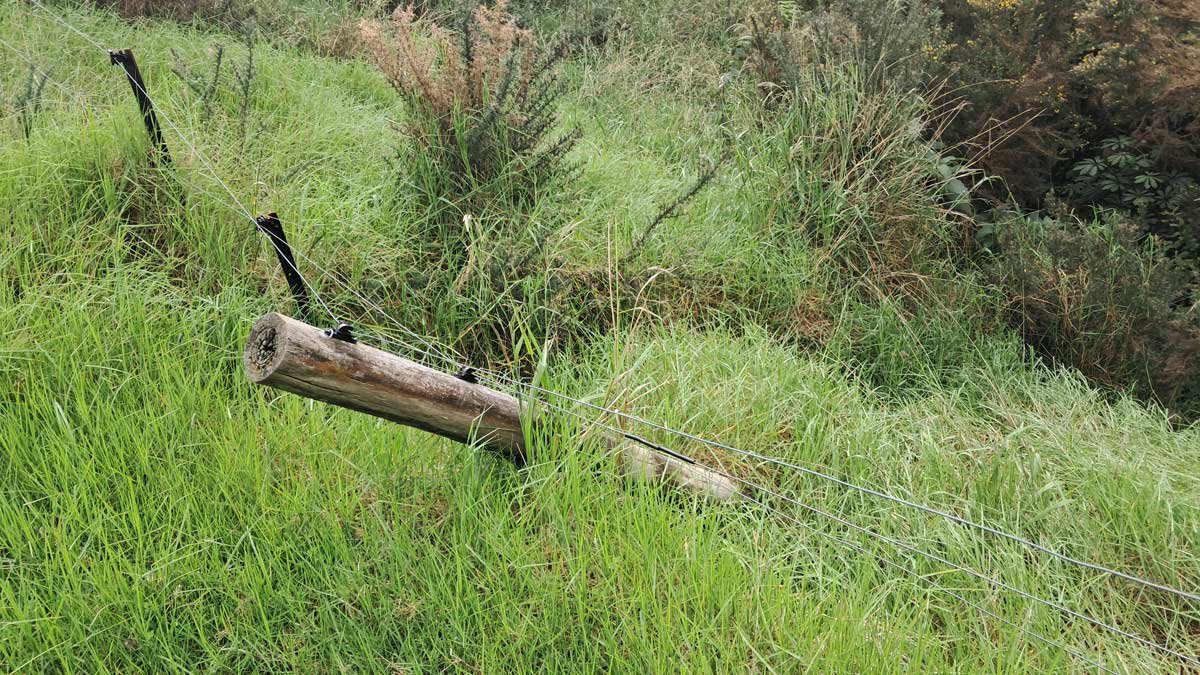
Shifting soils
Looking around more closely, I spotted changes in the gully which signalled we should get cattle off it, immediately.
The fence post was only the most-obvious sign something was wrong. Realising what was going on felt a bit like that scene in Dante's Peak where the couple boil alive in the spa—an early warning something more sinister was happening below the surface.
It looked to me like we needed to retire another section of this paddock. This time a very awkwardly-shaped one.
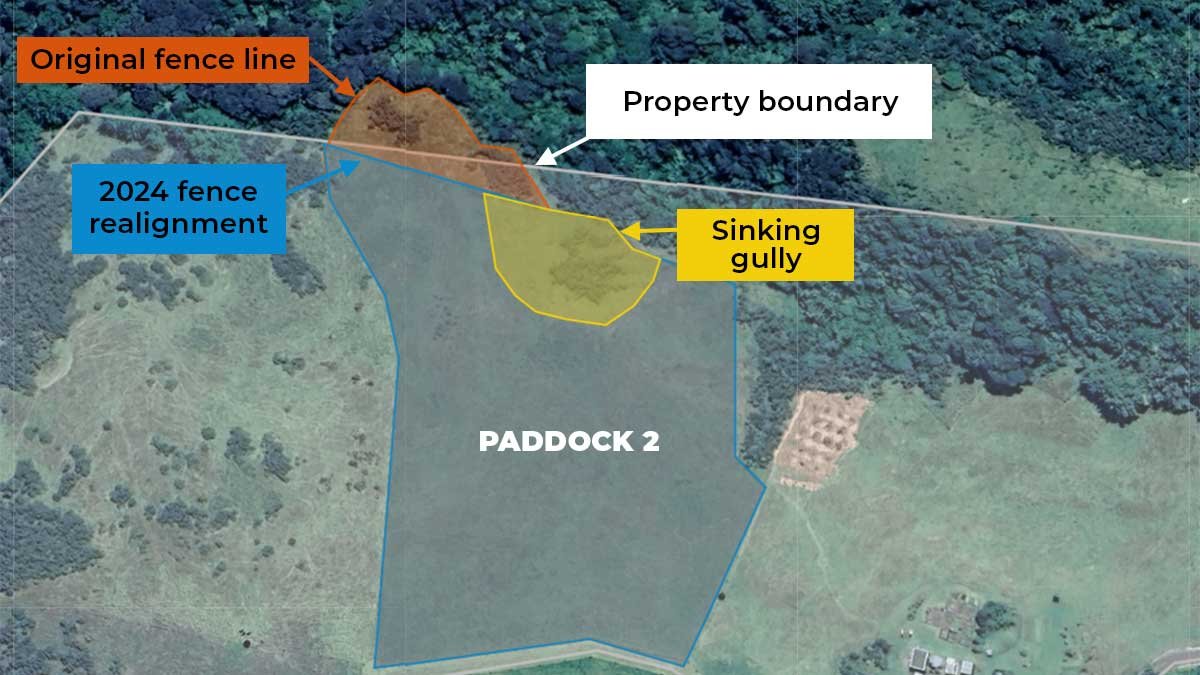
It's about the size of two tennis courts. Not gigantic in the scheme of things, but certainly much larger than our usual restoration efforts. It also needed more specialised plants.
This needed something that would grow fast, thrive in the conditions, and hold on to the land until the bush can take it back properly.
The gully
The gully sits between a ridge that encloses it. It contains a fairly large patch of gorse that we've elected to leave because in this case, it's helping.
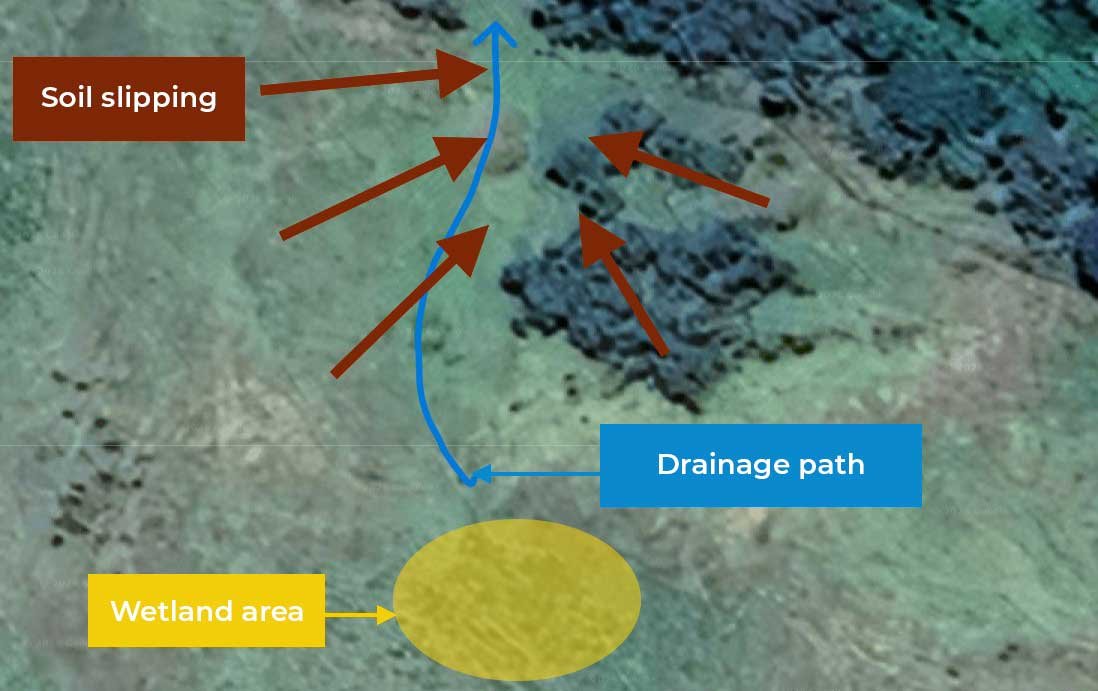
Water drains from an ex-wetland/pond above the ridge, down the gully, and out into the streams that border the property.
That water is causing some pretty significant erosion and subsidence over time.
I don't think it's a new problem. But I do think we need to take action before it becomes a really big problem.
The angle of that post wasn't great, it had been pushed up and out. Like the land spat it out.
On a longer-term vision note, I've always thought the pond above the ridge would make a good swimming hole. It's positioned in such a way we could construct a water-slide down the hill, ending in the pond.
But it would not be responsible recreation development unless we first secured and restored the area that it ultimately drains into. This gully needs closing off and planting. It's always been part of the plan.
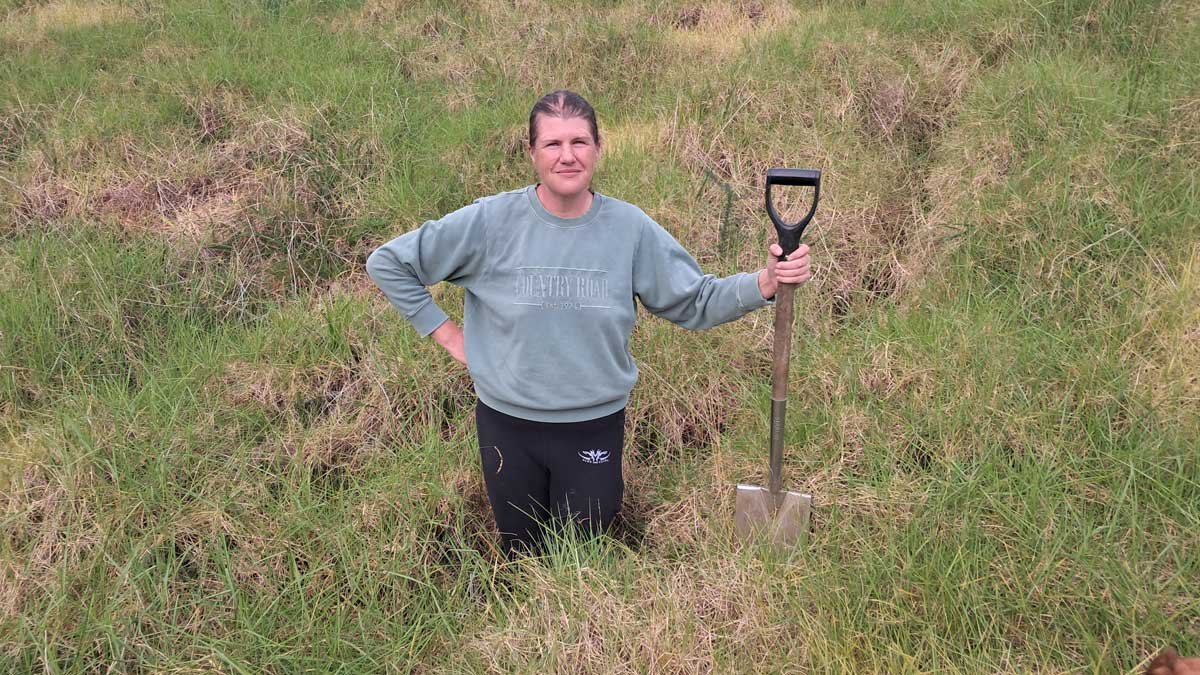
This photo was taken towards the top of the 'drainage path' on the satellite image above, while the crooked fence-post was located at the bottom.
The spade is sitting on the soil-level. My feet are inside the ditch that has been carved by water (possibly helped by people), over at least a few decades.
The swimming hole and water slide are still years away. But the land was sending us a very clear message that restoration on the path to that project needed to start sooner, rather than later.
Site preparation
We immediately went out with a pile of pigtail posts and polywire to rope it off from the Surprise Cows. I'm not sure it's the most ideal path for our eventual fence, but it'll do in the meantime.
Then we started doing all the work one needs to do to immediately stand something like this up.
I went out there with a backpack of glyphosate to kill back the kikuyu grass around some planting spots. You can see it dying around me in the above photo.
Then I needed to find plants. I never got around to growing the hundreds of natives it would be very handy to have about now last year.
So to begin this planting, I'm scrambling a little, on a squeezed budget. I'm looking in more-unusual places.
The priority right now is to hold the land. Stop it slipping away and filter any run-off before it leaves the boundary and out into the ocean. That means we need plants suited to wet places, with big root zones.
I've settled on three species for Stage One of the project.
Planting plan
First up is poplar. A non-native, but perfectly suited to the work of growing fast and holding soils.
They can be grown by planting branches from existing trees into the ground during dormancy. There's a council nursery that provides especially-grown poles for this purpose; but there are also several 20-30 year old poplars around our subdivision that are in dire need of a prune.
These trees are already proven in this environment. So we'll be pruning our existing poplars to see what happens when we just... shove them in the ground.
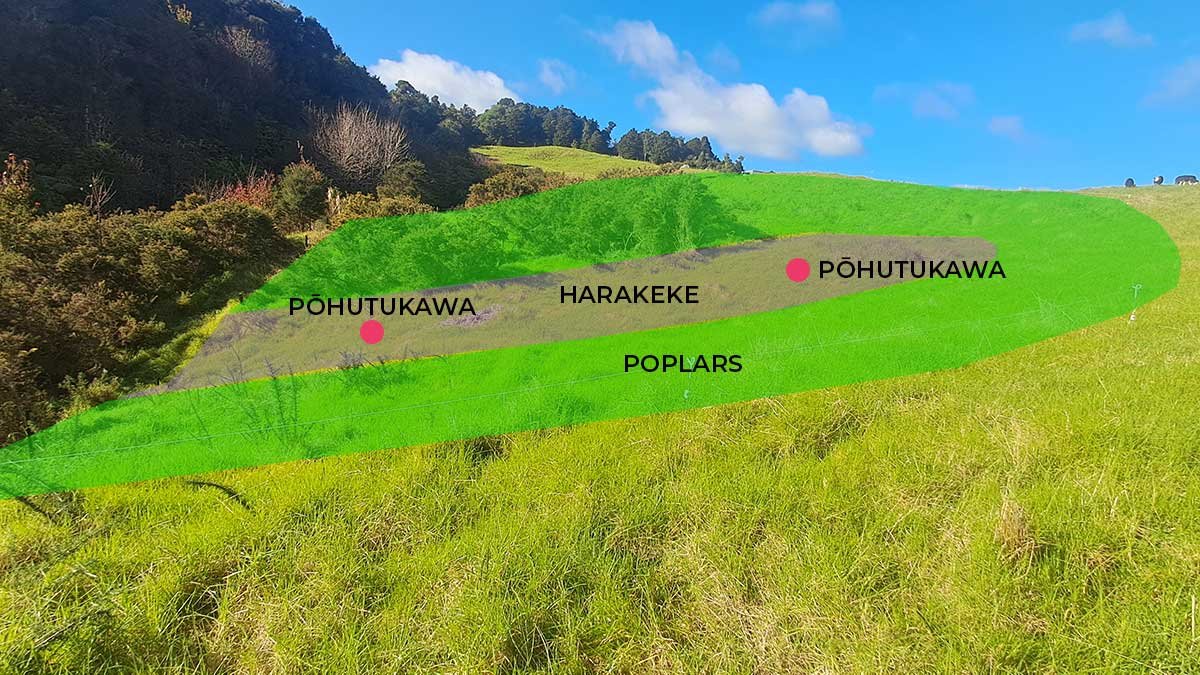
They'll be mostly around the edges of the gully (green), planted 3-4 meters apart.
A harakeke (New Zealand flax) plant needed removing from the gardens I care for at work. With nowhere to redistribute it there, I 'swapped' them some spring bulbs from my garden, as well as a couple of bags of soil. A win-win for both properties.
That gave us about 20 individual starts. They will go down the middle of the gully, where the water flows off, to act as both a filter and anchor for the soil.
Finally, instead of letting two self-seeded pōhutukawa grow underneath the buildings at work and become a giant headache there, I picked them up as part of my 'swap' too.
It's the kind of plant that requires a bit of consideration before putting in, especially near things like pipes and buildings. It's a native and locally-sourced, but it's not native to our particular patch of bush.
But they are perfect for a spot with a lot of water running through it, just down the hill from a swimming hole with a water slide. This area is fairly remote as far as our property is concerned and their size is a bonus, rather than an impediment.
Placing them far apart, directly in the water's path felt like it might be a clever move.
Time for action
The planting spots are dying back now. We've dragged down the harakeke and a spade. We'll be spending the next few weeks pruning poplars, digging holes, and planting.
It's likely this project will need a Stage Two to plant in more natives. But once the trees are established, the birds will likely do the rest of the work by planting secondary species from seedbanks in the surrounding native bush.
It's only a small area of this paddock, but it's also the biggest planting we've done in a single year. So stay tuned to see how it goes.
READ NEXT
The lost fence post
The post was abandoned, but the fencing project was not.
Stay in touch?
The Kat's Garden newsletter gives readers an extra peek behind the scenes. It's the best way to know when new posts go live, and what's happened since.
If you like what you've seen, join us and see what we learn next.