
It's ANZAC Day today. Since I took up my family history research, I've gained more insight into what this day means for our family. I try to use it to reflect on our own fallen men.
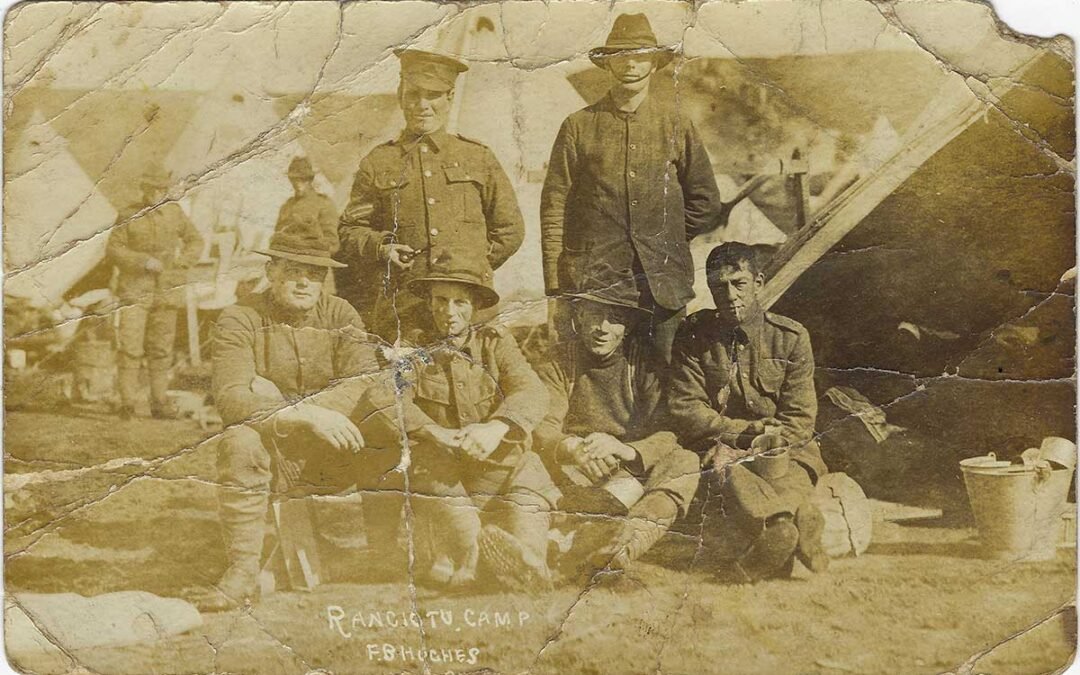
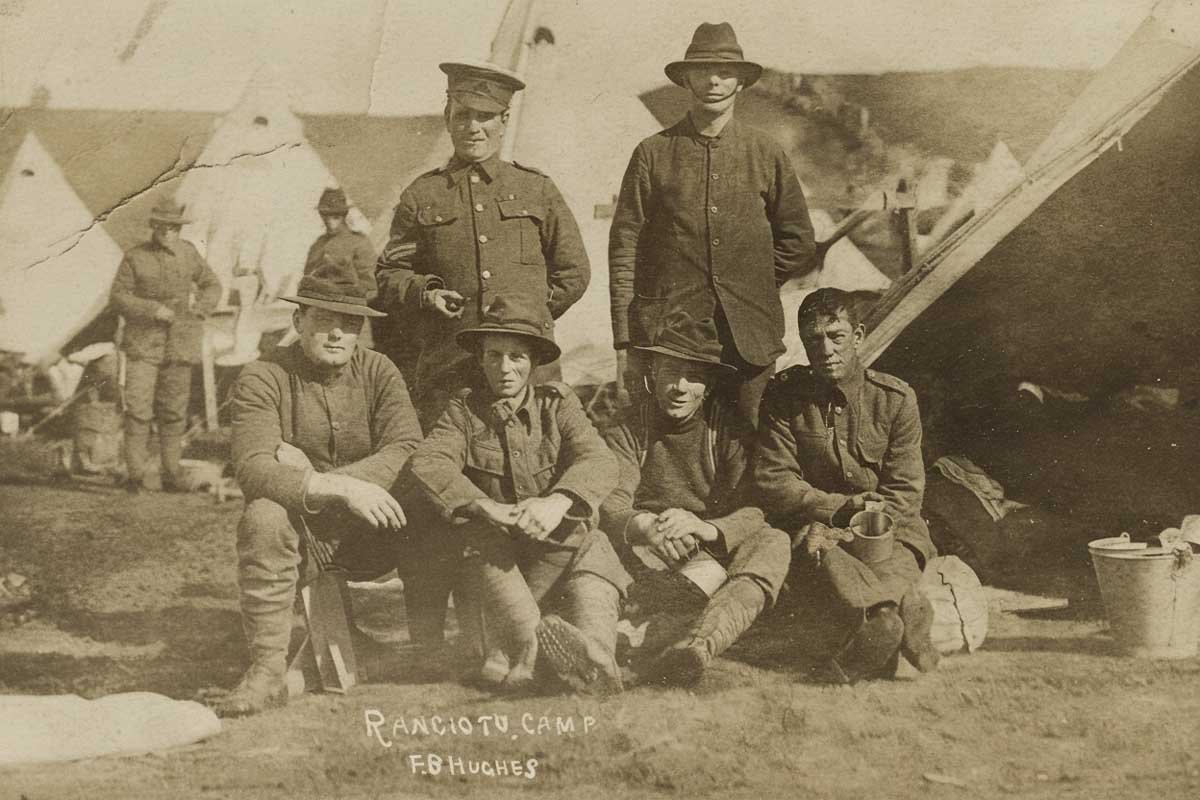
In the last year, the photo shown above has surfaced to be added to the family history collection. This version is the photo as it arrived with me. An AI-restored one is available at the end of this post.
On the back, it reads:
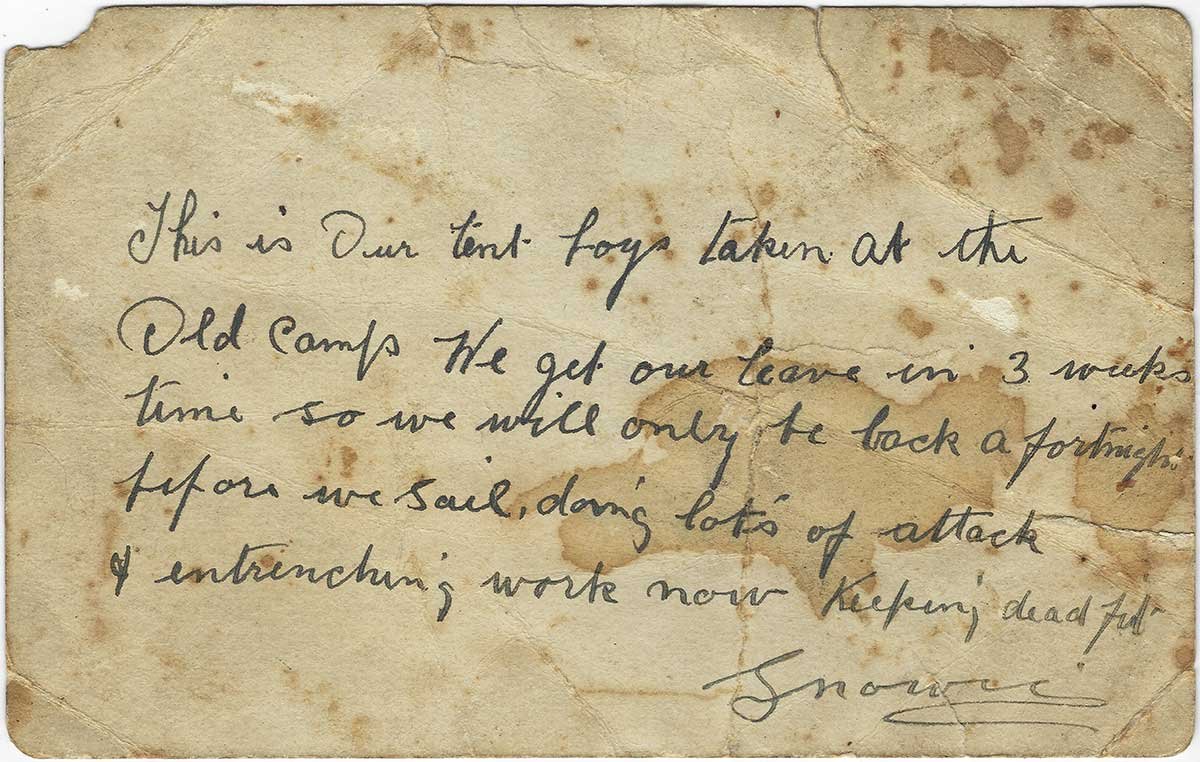
Transcription: This is our tent boys taken at the old camp. We get our leave in 3 weeks time so we will only be back a fortnight before we sail, doing lots of attack and entrenching work now. Keeping dead fit. Snowie.
I believe the photo was taken mid-1915, and was sent to Snowie's family around August of that year.
Rangiotu Camp was based near Palmerston North, and Snowie shipped out to Egypt on 9 October 1915.
Albert 'Snowie' Charles Schaeffer (1884-1920)
Albert (Snowie) Charles Schaeffer (war records; cenotaph) was born in Hastings on 22 August 1884. He was the youngest son of Annie (nee McFadyen) and Louis Martin Schaeffer.
Snowie was well-known and well-liked within his community, and worked as a hairdresser.
His war records state he was single; Roman Catholic; with dark complexion, blue eyes, and dark hair. He was 5ft 5in (165cm) tall and had a distinctive tattoo of a flag, and a scar on his left forearm.
Snowie enlisted in the army on 31 May 1915 at Trentham, aged 31. He was assigned to C Company, 1st Battalion, Trentham Regiment, 3rd New Zealand (Rifle) Brigade and had previously served 4 years with the Hastings Rifles.
After enlisting and before being sent overseas for service, troops were trained at domestic training camps. Many New Zealanders have heard of Trentham, but Rangiotu was a satellite training camp. That's where he was when he sent this letter home.
Snowie began making trouble almost as soon as he arrived. His records indicate he never took his service too seriously.
Misconduct
Snowie's conduct sheet is longer than most I've seen.
The first entry records an offence of "breaking camp and drunkenness" in Palmerston North on 13 July 1915, and resulted in 10 days confined to barracks. This was likely about the same time (and possibly with the same men) as featured in the photo.
After shipping out, Snowie first went to Egypt, spending four and a half months there, as part of the early defence against The Senussi Campaign.
His ship arrived in Suez on 15 November. Within 10 days of arrival, his conduct sheet records not one, but two more incidents.
24.11.1915: While on A.S. [active service] absent without leave from 9 a.m. to 9.30 p.m. Punishment: 96 hrs detention.
25.11.1915: Absent from 3pm to 9.30 p.m. while on active service.
Punishment: Forfeits 2 days pay by R.W. [Royal Warrant]
Let's just say this man had a brand, and he was on-it. It didn't deter him for long. On 23 February 1916, he was written up again.
Location: Mersah Matruh. While on active service, absent without leave from 6am till 9.30pm on 23.2.16, and absent from Physical Drill parade at 7.00am.
Punishment: Deprived of 5 days pay. Forfeits 1 day pay by R.W. [Royal Warrant]
This punishment was authorised by Major W.S. Austin, who is described in his cenotaph record as a "firm but fair officer who believed good soldiers came as a result of hard training."
On 6 April 1916, Snowie was shipped out to France and the Western Front. He was a good boy for a few months, before getting in really big trouble.
Location: Bois Grenares [sic].
2.8.1916: Absent without leave when on active duty and drunkenness on duty.
Punishment: Forfeits 40 days pay, ordinary.
He wasn't to know it, but 40 days later life would be quite different for Snowie.
Disquiet on the Western Front
Just two days after being both AWOL and drunk on duty, Snowie was involved in an incident that ended his military career. It set in motion the events which eventually ended his life.
On 4 August 1916, Snowie was in the Armentières sector, right on the Western Front. To understand what happened next, it pays to know a little bit about where he was. Ngā Tapuwae explains:
"The New Zealand Division was stationed in Armentières from May to August 1916. On arrival in France, they were given gas masks, and then at Armentières, steel helmets. It signalled that this was going to be a very different style of trench warfare to that which they had experienced in Gallipoli.
The trenches they occupied stretched from the east to south-east of Armentières, and were in a bad state. Armentières had a high water table, so these trenches were damp and needed constant maintenance. They couldn’t be dug too deep, and sandbags were stacked up inside them to give extra height to their walls."
Snowie was in those trenches, in a dug out (a shelter cut into the side of a trench), and was buried by a shell blast.
Somehow, he survived that. He might have even been OK. Except around four hours later another shell went off, burying him beneath one of those sandbag walls.
A steel helmet can only help so much. Snowie was evacuated with shell shock and facial paralysis, and was later diagnosed with "a loud mitral systolic murmur". Basically, his heart valve was badly damaged, and it was leaking with every beat.
Recovery and discharge
After his evacuation, Snowie was bounced around between a few hospitals. By September he'd made it to England where once again, he found a way to get in trouble.
Location: Grey Towers.
23.9.1916: Went out 10 to 10.25.
Punishment: 2 days C.B. [confined to barracks]
Barely out of that punishment, he kept true to form:
Location: Grey Towers.
27.09.1916: Drinking beer while in hospital blues [the distinctive blue uniform issued to recovering soldiers].
Punishment: 14 days C.B. [confined to barracks]
And that's where he was when the Medical Board met to discuss his future. They noted:
"The facial paralysis is improving. One side of the face is 'drawn up' on smiling. Heart lesion, mitral systolic murmur & symptoms of loss of compensation."
Snowie was deemed Permanently Unfit for service on November 3 1916. He was back on a boat back to New Zealand 10 days later.
The files related to his discharge note:
"This soldier's record shows him to have been most impatient of discipline. He has never been charged with any offence of a fraudulent or dishonest nature but cannot be given a better character than indifferent."
Back at home
Snowie arrived back in New Zealand on 21 January 1917. A note was published in the Personal section of the Hawke's Bay Tribune on the 6th to let people know he was coming back, and was suffering "shell shock".
On March 6, the Medical Board in Rotorua confirmed the permanent unfitness verdict. They noted that "probably too much alcohol" contributed to his (lack of) recovery. Snowie was formally discharged 3 weeks later on March 27 1917.
He was discharged to Queen Mary Hospital in Hanmer Springs. It was opened in 1915 as a site for "rehabilitation for mental and nervous conditions, particularly shell-shock." It appears he was there on and off for most of the remainder of his life.
Snowie died at Trentham Hospital on 18 September 1920 of "chronic interstitial nephritis" (kidney failure). He was 36, and had no children.
That date and this entire period must have been gut-wrenching for the family. They had lost another family member—Snowie's nephew Louis "Bunny" Schaeffer—on exactly the same day in the Battle of the Somme in France just 4 years prior. Bunny died on the battlefield about 6 weeks after Snowie's original injuries in Armentières.
The Hawke's Bay Tribune published an obituary on 20 September that reads:
"The death is announced of a well known Hastings resident, in the person of Mr. Albert Charles Schaeffer, familiarly known as “Snowy,” who passed away at the Trentham Military Hospital on Saturday. Deceased, who was 36 years of age and unmarried, was the youngest son of the late Louis Martin and Annie Schaeffer, of Hastings. He served in the great war, having joined up with the 7th reinforcements, and returned suffering from shell shock. He had been in the hospital, on and off, for the last six months; and latterly developed paralysis. He was very popular amongst those who knew him, and his death will be learnt with sincere regret. The funeral will leave the Catholic Church, for the Hastings cemetery, on Wednesday, at 2.30 p.m.
Snowie was buried in Hastings Cemetery.
"Keeping dead fit. Snowie."

READ NEXT
The three wives of John William Lewis
My great great grandfather was cut from our family tree. I spent years digging him up and was surprised to learn we were only his first family.
READ NEXT
Nana Retter's fruit cake
My great grandmother, Nana Retter, was Snowie's niece. Her baking is fondly remembered by everyone I've talked to. In late-2022, I made her famous fruit cake.
Related content: Anzac Day · Armentières · Egypt · family history · France · Gallipoli · genealogy · Hanmer Springs · military history · New Zealand history · New Zealand soldiers · Rangiotu Camp · Schaeffer · Senussi Campaign · shell shock · Trentham · Western Front · World War One · WW1
Stay in touch?
The Kat's Garden newsletter gives readers an extra peek behind the scenes. It's the best way to know when new posts go live, and what's happened since.
If you like what you've seen, join us and see what we learn next.




That was fascinating. It sounds like quite a character.
Hello, thank you for this article. I came across it while looking into my family history. It turns out that he is a relative of mine also. He is my grandfather’s uncle.
Hello! Nice to meat you, we must be cousins of some kind!! You’re very welcome, I’m glad it was useful. 😊
Hi Kat, my Dad was William Martin Schaeffer (nickname Dick) and he was Toots’ youngest son. Kathryn is my daughter and I have enjoyed reading about my Dad’s family so thank you to you and Kathryn for the research. It seems, from what I remember that alcohol was prevalent with some of the boys. My dad told me some stories about Toots and Dad’s brothers. I remember Aunty Tot and Uncle Jack Retter as we used to visit them in Napier. Aunty Tot was my Dad’s older sister and she was an excellent baker.