
Last month, I introduced the blog to what we're calling "The Sinking Gully", and our plans to protect and re-vegetate it.
Since then, we've been working to do what we can. When the weather, our usual responsibilities, and energy levels all line up to give us the opportunity.
When I published the last blog, we thought we'd get this done pretty fast. We had a rough plan that seemed feasible. But the reality of working in winter, without a transport system to site has meant slow progress.
Still, there has been progress, so what have we been up to?
The two-fer
Our Regional Council provides poplar poles each winter for erosion control, but that requires ordering them, paying for them, and a three hour return trip to the council nursery to pick them up. And it felt like there was a more elegant solution just up the hill.
On our shared driveway, a row of poplar trees were encroaching on the communal driving space. They've needed pruning for a while, and someone had to volunteer to do it or we'd all be sharing an arborist bill eventually.
They're probably at least 20 years old and haven't seeded or suckered to any major degree. There's a good chance they came from the council themselves.
We decided to get maximum value out of this project by pruning the lower branches to clear the driveway. Then install them in our valley to grow our new poplars.
One job, two outcomes, a win all round.
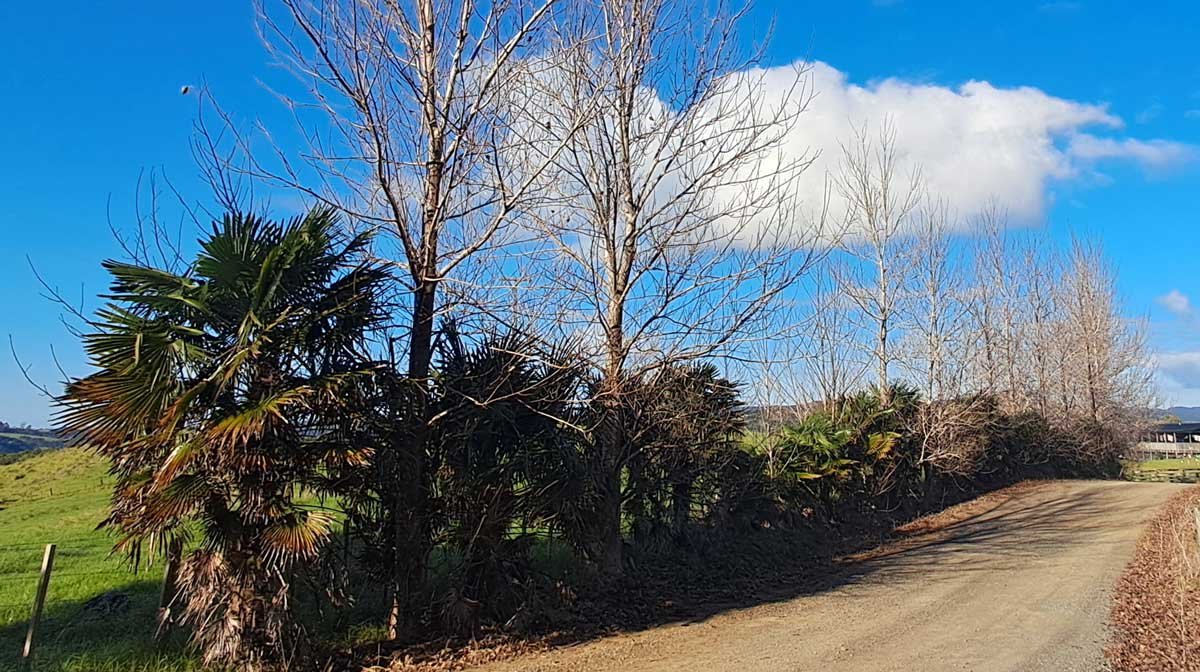
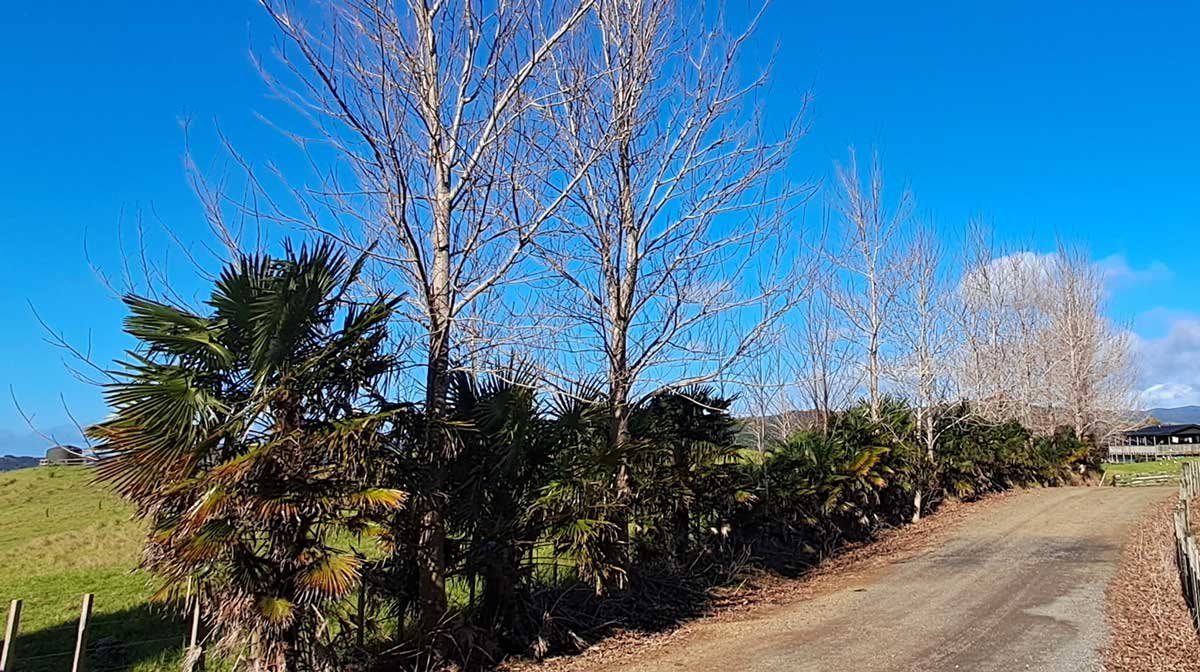
This has taken a few sessions, and we're still not quite finished. We've worked our way down the row taking off the lower-branches, but there's still the higher ones to do with a pole saw and ladder.
As we pruned the poplars back, we kept our eyes out for straight branches between about 3 and 6cm in diameter.
At first we only wanted long (>2m) ones, though as we've learned what we're doing, we've found that 1.5m was sufficient and being straight is far more important. On our first trip, we limited ourselves to bringing back around 10-15 poles.
We learned that was actually a decent morning's work, and we've continued at this pace.
Learning as we go
After my last post, a lovely reader with experience in planting and caring for trees got in touch, wondering if I wanted advice.
I did want advice. I sent her an overview of my original plan, and on a video call she told me which parts of it made sense, and which could be improved.
That call saved us a tonne of work and energy. Whatever success we end up seeing by next autumn, will have a lot to do with what I learned.
One major change to the plan following the advice was the decision not to lug a post-hole borer down to the site to dig holes. It would have been a lot of work simply to transport it there, and it turned out, could negatively impact our success rate.
She definitely implied that the poles offered by the council would be a better idea as we'd know what we were planting. As we've progressed on the project, I've come to see her point about sourcing poles, but not for the same reason.
The poles we're using aren't straight or uniform. They have branches that get in the way and need to be trimmed close. We've rejected a few for insect damage.
That's led to some silly angles and wasted energy that would have been avoided with straight, uniform poles from a supplier.
If you happen to be here trying to figure out if you should buy your poplar poles, my answer is yes. It'll make the job far easier for you than the one we had.
The long trek
Once we brought those branches home in the car, we needed to get them to the site.
Our quad bike died about a year ago. Richard has miraculously managed to revive it, but it's currently stranded in Ruakaka. I am utterly uninterested in the idea of getting our car stuck in a paddock. So we had to rely on more manual modes of transport.
The first time, we took the poles down in a wheelbarrow. Getting it down through an uneven paddock was difficult enough.
Getting it back up the hill in the same paddock pocked with muddy hoof prints was real work!
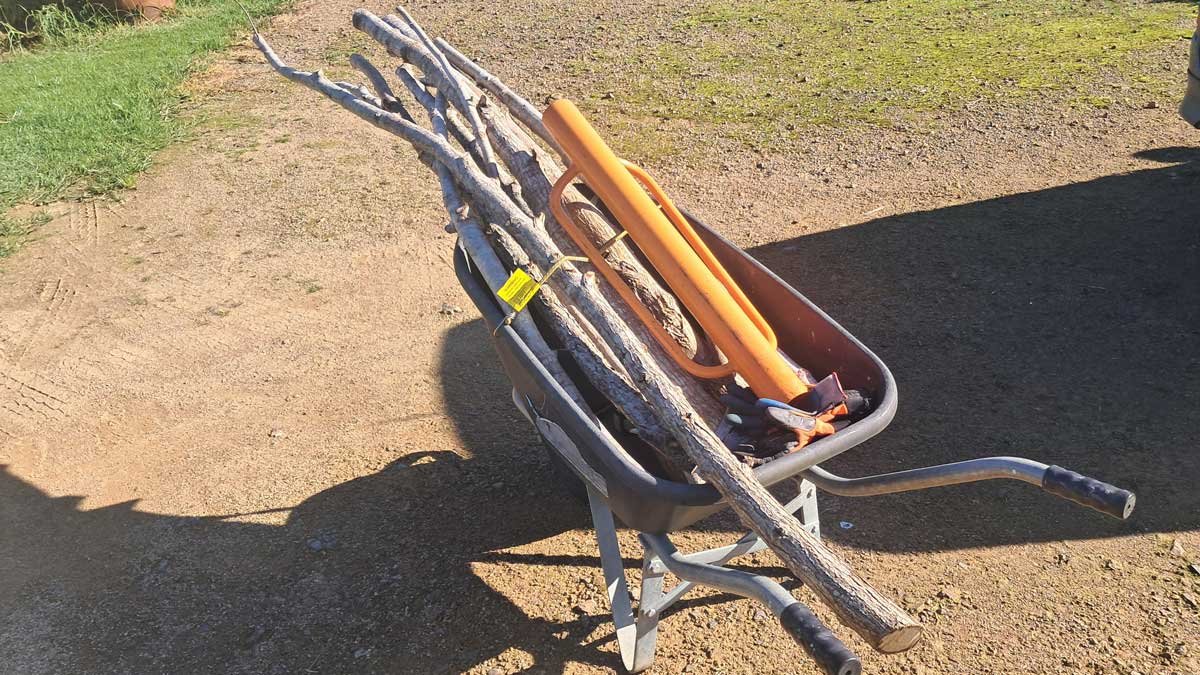
The second time, we strapped the branches together, with each of us holding one end as we walked them down, sans wheelbarrow.
That was the method that actually worked.
Bang 'em in
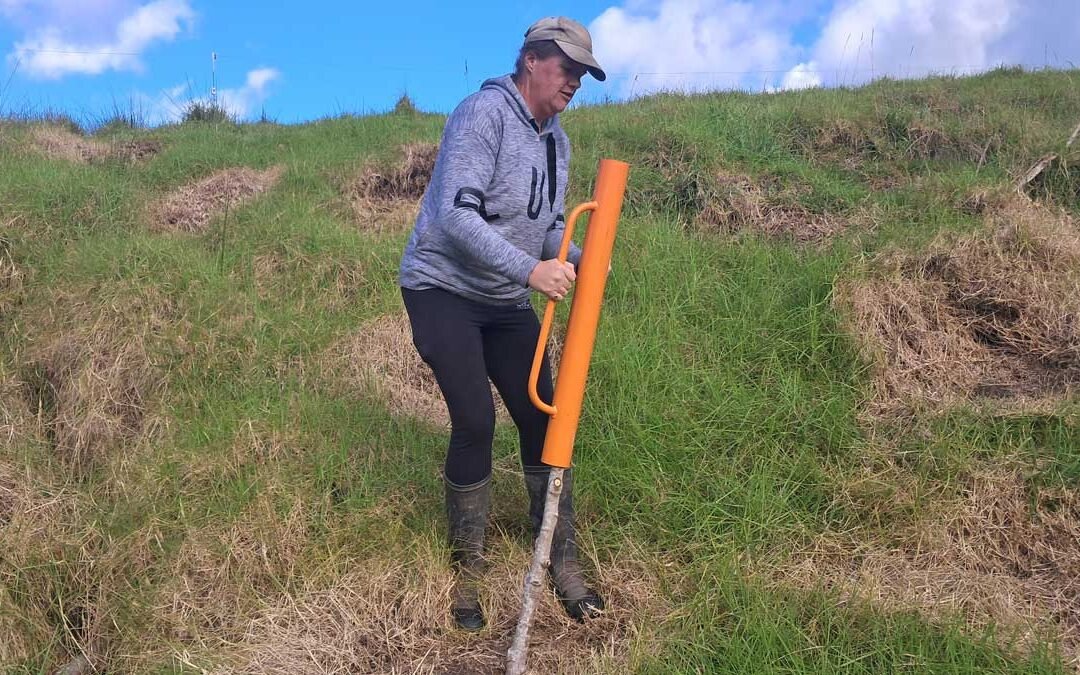
It turns out the best way to install poplar poles is with a post driver—a heavy metal tube closed at one end, with handles. It slips over one end of the branch and forces it straight into the soil.
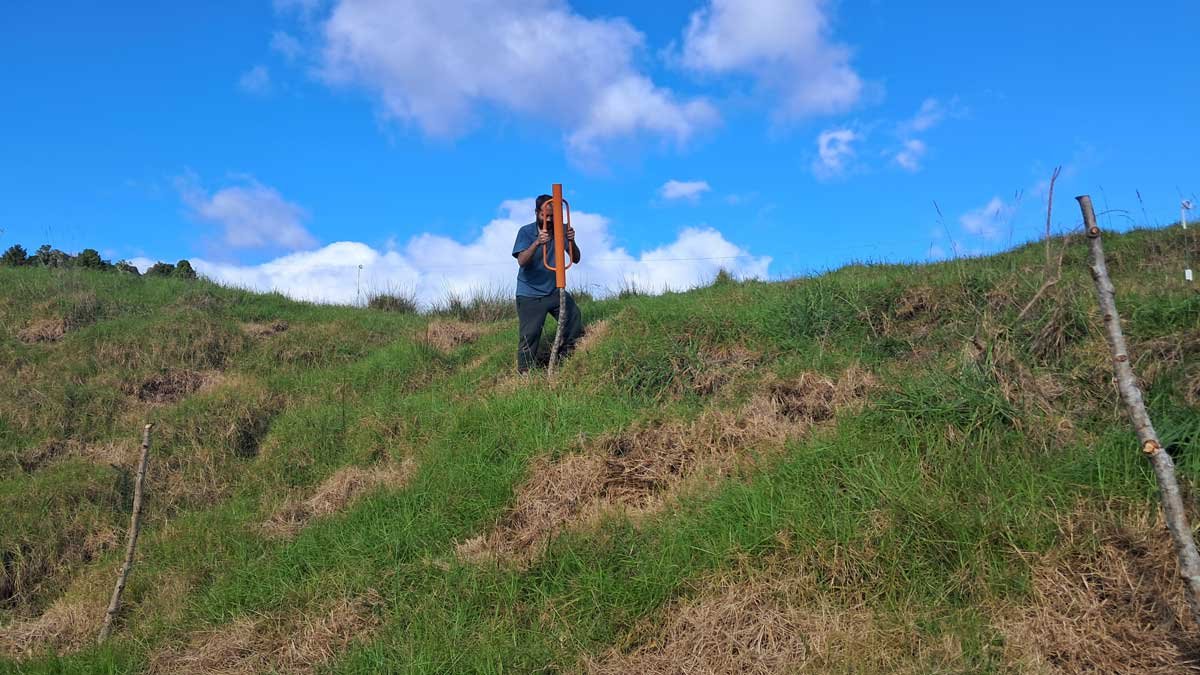
This means basically zero air pockets in the soil around the branch, and a better chance of success than if we'd used a post hole borer.
It also determined the maximum diameter of the branches we could select, and a minimum 'straightness'. We learned that the hard way after getting a couple of branches stuck inside the post driver.
Each of the spots I'd sprayed was blasted with the line trimmer to remove the tough ropes of kikuyu grass that would otherwise make this job difficult. Then we banged in the poles.
Once they were in, we used our mini chainsaw to cut a 45° angle at the top of each one to tidy it up and ensure any rain ran off.
While we brought the mini chainsaw and line trimmer back and forth from the compound on each trip, we ended up leaving a spade and our post driver down at the site.
Carting them back and forth (up and down) each time felt like a waste of energy, and is another reason to be grateful the post hole borer wasn't involved.
The natives
On days that weren't dry enough to prune the poplars, we wandered down to plant the native plants. We carted an entire tray of harakeke (New Zealand flax) down in one trip and planted them whenever we had the chance. They're all in now.
The pōhutukawa were transported down in a separate trip, but are both planted now as well. They're both right on the path of water flows. I think they'll thrive there.
But there are still a lot of sprayed and cleared spots to fill. The worst-affected area is now planted with enough poplars that I think we'll probably stop the downward creep. Some of these won't end up taking, but hopefully enough of them will.
So the area is now planted with poplars, and there are some natives planted and ready to take back this area, but there's still heaps of room for more.
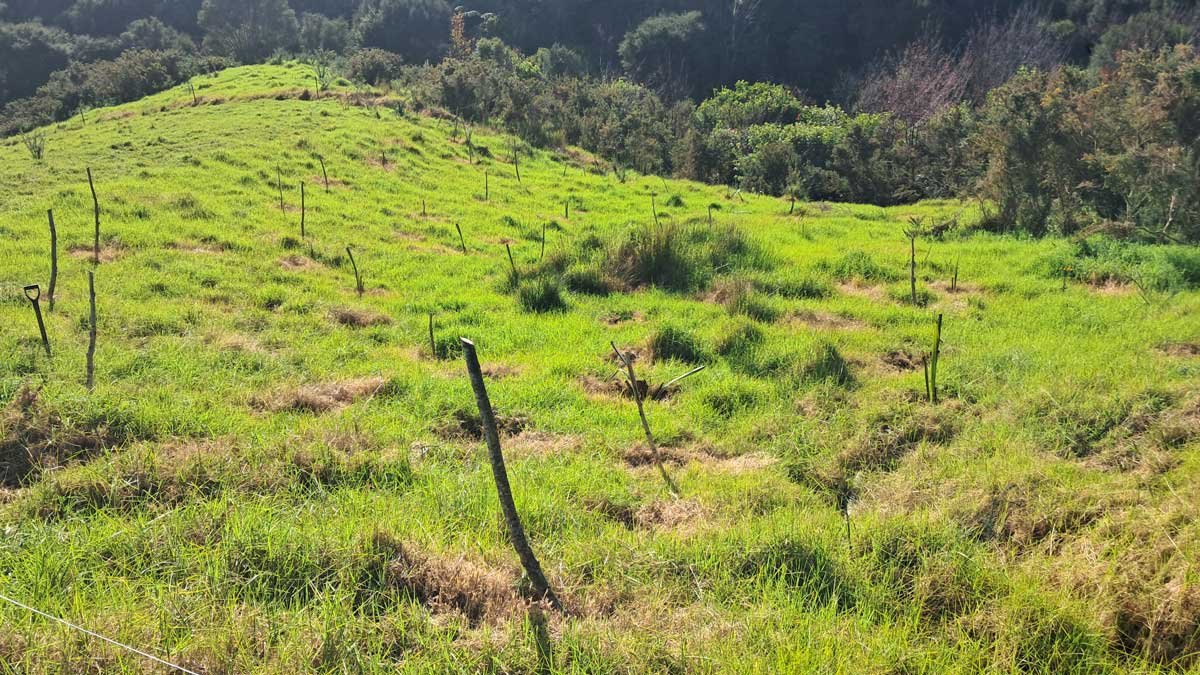
And that's where I'm hoping you come in.
Grow it forward
A local community-led nursery is holding a sale on locally-sourced native plants this month. Their timing could not be better.
I would really love to go down there and pick up some plants to add to this area before planting season comes to a close at the end of August.
I've got $50 of my own I am going to throw towards this, but if you happen to have $15 to spare towards a restoration project, I've got an offer to make.
The helpful team over at StickerDot offered me the opportunity to print some high-quality "bumper stickers".
They are printed on durable, weatherproof, and UV-resistant vinyl and built to withstand rain, sunlight, and tough outdoor conditions.
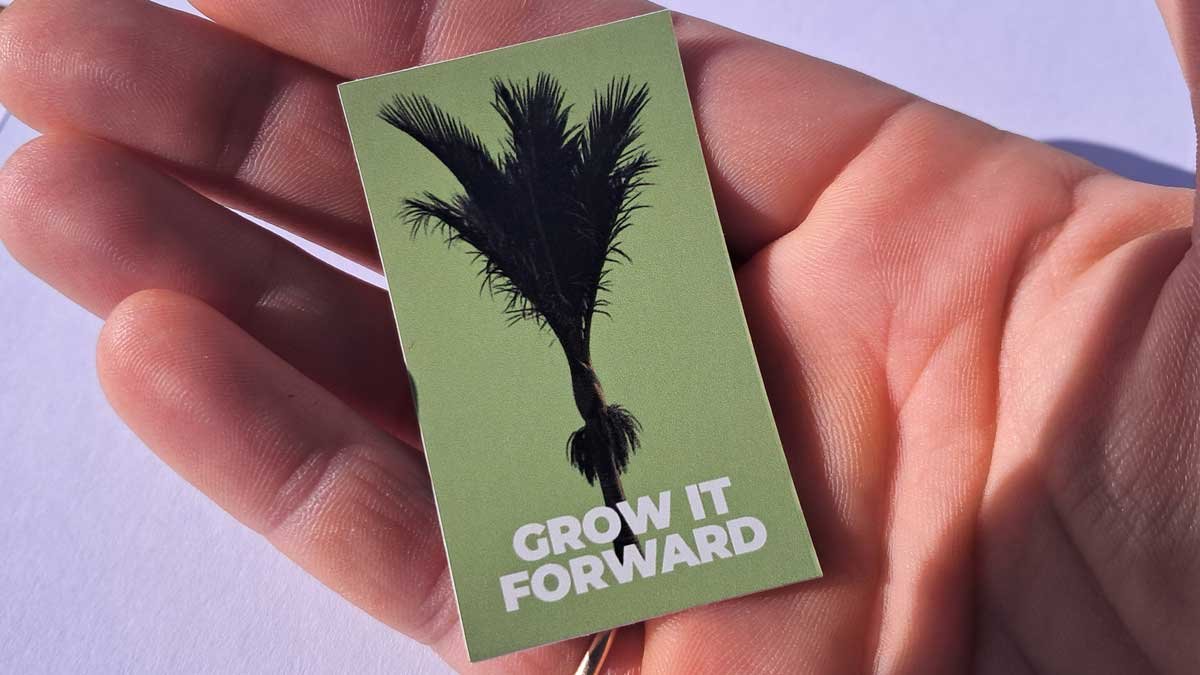
At 35x60mm, they're smaller than most bumper stickers, but perfect for laptops, drink bottles, or—yes—your car's bumper. And if you buy a sticker, I will do three things:
- I will plant at least one tree on your behalf this year (probably more, the sale looks very good).
- I will buy soil and propagation materials to grow my own trees from seed I collect (and document it here on the blog), then plant those trees next year. Again, at least one tree will be planted for you next year.
- You will get one of these very cute and high quality stickers to say thank you (limited to 100).
I chose nikau as our symbol because when you visit The Outpost, it's the tree that stands out in our bush.
It's our symbol of new life and a lasting commitment to increasing our ngahere, one chunk of paddock at a time.
Any funds raised in excess of what we need (or after August) will go towards better fencing around our planting to keep the cows off this vulnerable piece of land.
Thank you
If you're able to spare the donation, thank you. As a man who fixes lawnmowers, Richard won't let me plant tī kōuka (cabbage tree) in any place he has to mow.
But he'll never have to mow The Sinking Gully and he's agreed I can plant them down there. I love the shape of a mature cabbage tree and I'm really looking forward to adding them. They're the first plant I'll be looking for at Nairis Nursery.
But some mānuka, sedges, and perhaps some secondary species like pūriri or tōtara amongst the existing gorse now would mean the restoration occurs much faster in the future.
The planting window closes at the end of August so your help to maximise our efforts will really impact how successful this initial planting ultimately becomes.
The honest truth is only time will tell how many of these poplars actually survive and thrive. They're an emergency-intervention while we wait for the more suitable natives to take over.
The more natives we get in there now, the better this goes in the long term.
READ NEXT
The lost fence post
The work we did in 2023 which has led to the work we're now doing in 2026.
READ NEXT
The sinking gully
Why we're restoring this spot, and the original planting plan we went in with.
Related content: battery powered tools · cabbage tree · erosion control · grow it forward · harakeke · line trimmer · manual tools · native planting · pōhutukawa · poplar · post driver · restoration · Richard · sinking gully · tools



I remain so amazed by the ongoing learning and progress you (and Richard!) keep on making there. I’ve added some $ and am delighted to know I get to make a teensy addition to your work there.
Thank you! I am delighted you want to help! 💚
Great project!! Added some money, not sure if it came through in US or NZ dollars. 😂
Thanks Polly! Ko-fi is confirming it’s in $NZ. Be interesting to see how much it is to post a letter to New York in 2026, but your sticker will be on its way at some point 😊💚🌳
No need to send a sticker all the way to the US! 😀